In the United States, a dairy feed typically costs between $6 and $10 per day, depending on milk production levels, grain markets, and regional feed availability.
High-producing cows require energy-dense diets that combine forage crops with concentrated feeds rich in protein and energy. The cost of those ingredients shifts constantly with commodity markets.
A simplified breakdown of the average daily ration cost looks something like this:
| Feed Component | Typical Cost Per Cow |
|---|---|
| Corn silage and forage | $2.50 – $4.00 |
| Grain and energy feeds | $1.50 – $3.00 |
| Protein supplements | $1.50 – $2.50 |
| Minerals and vitamins | $0.30 – $0.50 |
Estimated Total Daily Feed Cost:
$6 – $10 per cow
For high-producing herds, that number can climb even higher when grain markets tighten.
According to cost-of-production research from the USDA Economic Research Service, feed expenses typically account for more than half of total dairy farm operating costs in the United States.
See the ERS dairy cost reports: https://www.ers.usda.gov/topics/animal-products/dairy/
That statistic explains why feed efficiency often determines whether a dairy farm remains profitable.
Must Read

Why Small Livestock Farms Are Struggling to Compete in U.S. Agriculture (2026)
Small livestock farms across the United States are facing rising feed costs, tighter margins, and increasing competition from large-scale operations. These economic pressures are making it harder for independent producers to remain competitive in 2026.
Why Feed Dominates Dairy Production Costs
Dairy cows are remarkable biological systems. A healthy cow can convert feed nutrients into milk with surprising efficiency.
But that efficiency depends on quantity.
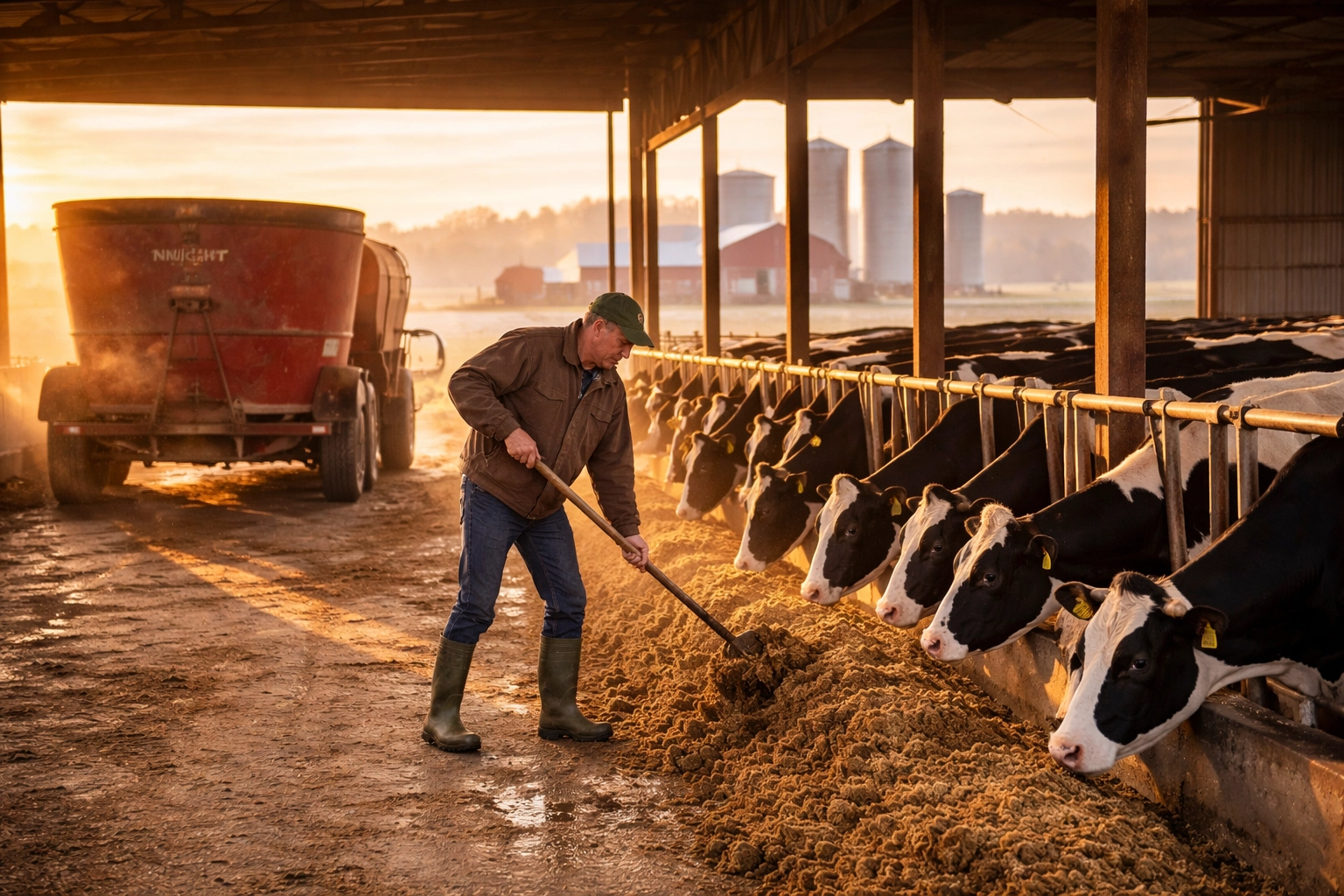
A typical high-producing dairy cow consumes 90 to 120 pounds of feed per day, usually delivered as a Total Mixed Ration (TMR). This ration blends forage and concentrated ingredients into a balanced diet that supports milk production and rumen health.
The ration must supply:
- Energy for milk production
- Fiber for digestive stability
- Protein for milk synthesis
- Minerals and vitamins for metabolism
Because cows consume large quantities of feed every day, even small price changes in feed ingredients can significantly affect farm budgets.
If corn prices rise by just a few cents per pound, the impact across a herd of several hundred cows becomes substantial.

The Two Foundations of Dairy Feed
Most dairy rations are built around two major feed categories: forage and concentrates.
Understanding these components helps explain why feed costs vary so widely across regions.
Forage Crops
Forages form the backbone of dairy diets. Common forage crops include:
- corn silage
- alfalfa haylage
- grass silage
- dry hay
These feeds provide fiber necessary for rumen digestion and help maintain cow health.
Many dairy farms grow their own forage crops to reduce reliance on purchased feed.
However, producing forage introduces its own risks. Weather conditions, pests, and crop diseases can reduce yields dramatically.
Crop statistics compiled by the USDA National Agricultural Statistics Service show how forage production can vary significantly between regions and seasons.
See NASS crop reports: https://www.nass.usda.gov
These variations directly influence feed availability on dairy farms.
Concentrated Feed Ingredients
While forage provides the dietary foundation, concentrated feeds deliver the nutrients needed for high milk production.
Common ingredients include:
- corn grain
- soybean meal
- distillers grains
- protein supplements
- mineral mixes
Unlike forage crops, these ingredients are often purchased from commodity markets.
Because they are traded internationally, their prices fluctuate according to global supply and demand.
This global connection means dairy farmers are often affected by economic conditions far beyond their local region.

The Influence of Grain Markets on Dairy Feed
Two commodities dominate dairy feed economics: corn and soybean meal.
Corn provides the primary energy source in most dairy rations, while soybean meal supplies the protein necessary for milk production.
Both commodities are globally traded.
When drought reduces corn production in the U.S. Midwest, feed prices rise nationwide. Similarly, increased global demand for soybean meal can drive up protein supplement costs.
Market outlook reports published by the U.S. Department of Agriculture track these commodity trends and their implications for livestock feed markets.
See the monthly WASDE outlook: https://www.usda.gov/oce/commodity/wasde
For dairy farmers, the challenge is timing.
Feed costs often rise quickly, while milk prices may respond more slowly. This mismatch creates a situation known as margin compression, where operating costs increase faster than farm revenue.
Read Also

How Dairy Farmers Manage Rising Feed Costs and Milk Price Volatility in 2026
Feed costs remain one of the biggest financial pressures for dairy farmers in 2026. Producers are adopting new ration strategies, market hedging, and efficiency improvements to manage volatile milk prices and rising input expenses.
Regional Differences in Dairy Feed Economics
Feed costs vary significantly across different parts of the United States.
In Wisconsin and Minnesota, many dairy farms produce their own corn silage and alfalfa. Favorable growing conditions allow farmers to grow much of their feed locally.
In contrast, dairy operations in California and Arizona rely more heavily on purchased feed transported from grain-producing regions.
Transportation alone can significantly increase feed costs.
Meanwhile, dairy farms in Idaho and New Mexico often operate large-scale dairies supported by irrigated feed production systems.
These regional differences illustrate how feed economics are shaped not only by commodity prices but also by geography and climate.
Comparing Feed Management Strategies

Dairy farms typically manage feed costs using one of three approaches.
| Feeding Strategy | Primary Feed Source | Economic Stability | Risk Exposure |
|---|---|---|---|
| Purchased Feed | Market-bought ingredients | Flexible | Sensitive to price spikes |
| Homegrown Feed | Farm-produced forage | More stable in good crop years | Weather risk |
| Hybrid System | Mix of both | Balanced stability | Moderate complexity |
The comparison reveals that feed management is fundamentally a risk management strategy.
Farms relying entirely on purchased feed face market volatility. Farms growing their own forage face crop risk.
Many dairy operations therefore combine both strategies to balance economic stability.
What the Comparison Reveals
The most resilient dairy farms often operate hybrid feeding systems.
Producing forage on-farm provides baseline feed security. Purchasing protein supplements and grains offers flexibility when market conditions change.
This balance helps farmers manage both commodity price volatility and crop production risk.
Feed strategy, in effect, becomes a financial hedge.
Technology and Feed Efficiency
Modern dairy farms increasingly use technology to manage feed more precisely.
Automated feeding systems measure ingredient quantities with remarkable accuracy. Dairy management software allows nutritionists to track milk production from individual cows and adjust feed rations accordingly.
These tools improve feed conversion efficiency—meaning cows produce more milk from the same amount of feed.
However, adopting such technology requires capital investment.
Agricultural credit surveys published by the Federal Reserve Bank of Kansas City show that livestock farms frequently finance feed mixers, storage systems, and automated feeding equipment through long-term agricultural loans.
See agricultural credit reports: https://www.kansascityfed.org/agriculture/ag-credit-survey/
While these investments improve efficiency, they also add financial pressure when milk prices decline.

Policy, Feed Crops, and the Wider Economy
Feed costs are also shaped by agricultural policy.
Crop insurance programs, conservation incentives, and federal farm programs influence how feed crops such as corn and soybeans are produced.
Economic analysis by the Congressional Budget Office explains how federal farm programs affect commodity markets and farm income stability.
See the CBO agriculture policy overview: https://www.cbo.gov/topics/agriculture
Although these programs are not designed specifically for dairy farms, they influence the grain markets that ultimately determine livestock feed prices.
Why Dairy Feed Costs Matter Beyond the Dairy Industry
Feed economics connect multiple sectors of American agriculture.
Grain producers depend on livestock feed demand to support corn and soybean markets. Dairy farmers depend on affordable grain to sustain milk production.
When drought reduces corn yields in the Midwest, feed costs rise for dairy farms nationwide.
Conversely, strong grain harvests can lower feed prices and improve dairy profitability.
This interconnected system means that feed economics ripple through the entire agricultural economy.
Understanding dairy feed costs therefore offers insight into broader agricultural trends.

Back at the Barn
As the morning feeding ends, the Wisconsin farmer watches the cows settle along the feed bunk.
The ration in front of them represents months of planning—crop production, grain purchases, and nutritional balancing.
Within hours, that feed will be converted into milk flowing into the bulk tank.
The economics behind that ration remain uncertain. Grain prices may shift. Milk markets may fluctuate.
But the fundamental equation of dairy farming remains unchanged.
Healthy cows, balanced nutrition, and careful management still determine success.
And every morning before sunrise, the quiet math of dairy farming begins again at the feed bunk.

Written by Janardan Tharkar – an agriculture content researcher and blogging professional with practical experience in farming education, digital publishing, and SEO content optimization. Janardan focuses on modern U.S. agriculture trends, smart farming technologies, irrigation systems, crop development, organic farming practices, and farmer-support programs to create helpful, practical, and trustworthy content for American readers.