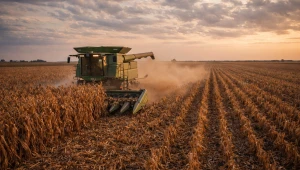
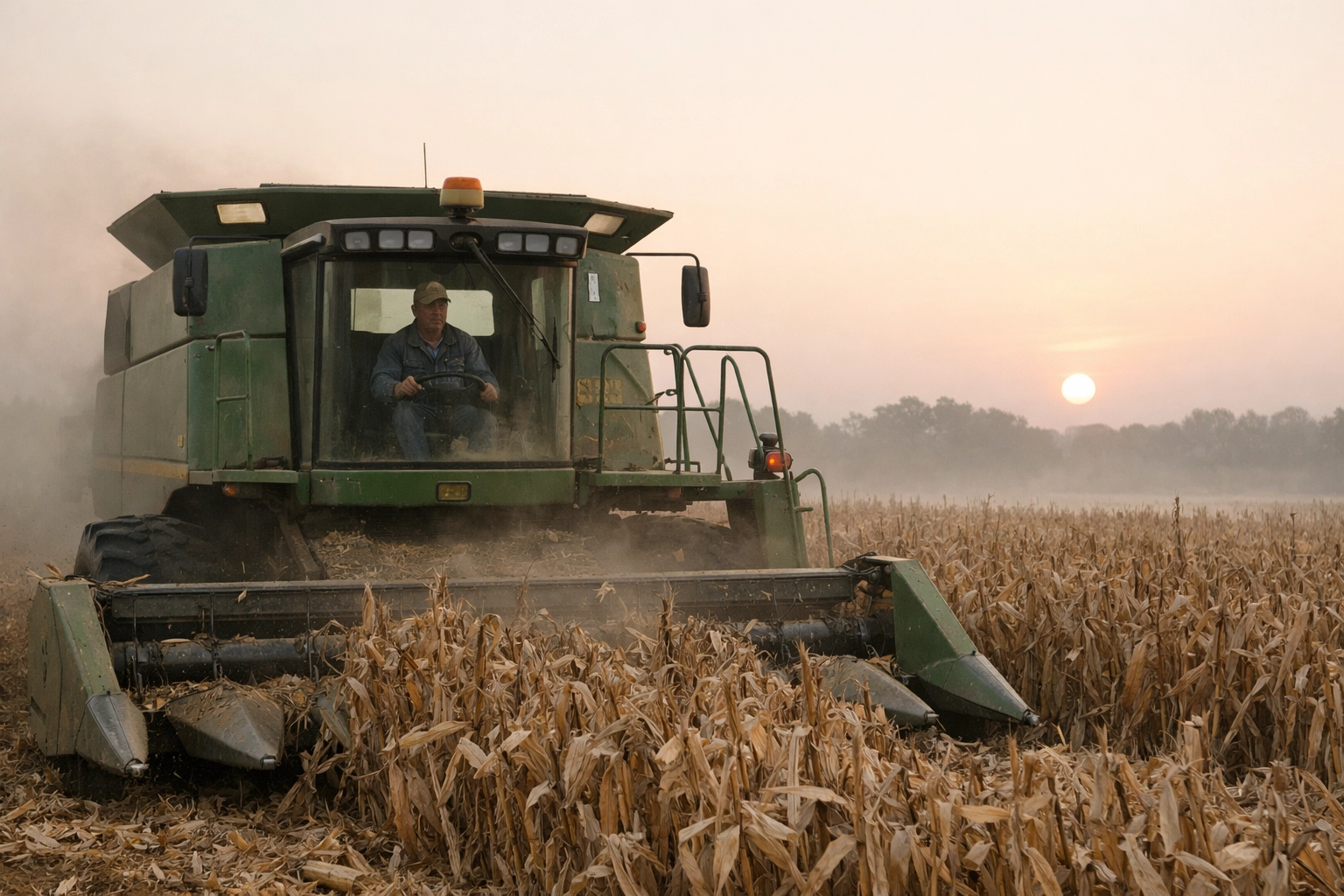
Before sunrise, the combines were already idling at the edge of a field outside Decatur, Illinois. The air carried that familiar early-autumn chill—sharp enough to signal urgency, but quiet enough to let farmers think. Rows of corn stood dry and ready. But in 2026, readiness hasn’t guaranteed confidence.
For Mark Jensen, managing nearly 2,400 acres across central Illinois, harvest this year is less about how much the field gives—and more about what the market takes away.
“We had the crop lined up,” he said, watching the first pass cut through brittle stalks. “But the numbers changed on us.”
That shift—between field expectations and economic reality—is defining the Midwest corn harvest in 2026.
Midwest Corn Harvest 2026 Begins with Uneven Field Conditions
The growing season never fully settled into a predictable pattern.
Spring planting windows opened on time across much of the Midwest. Fields in Illinois, Iowa, and Indiana were seeded efficiently. Early emergence looked promising. But consistency didn’t last.
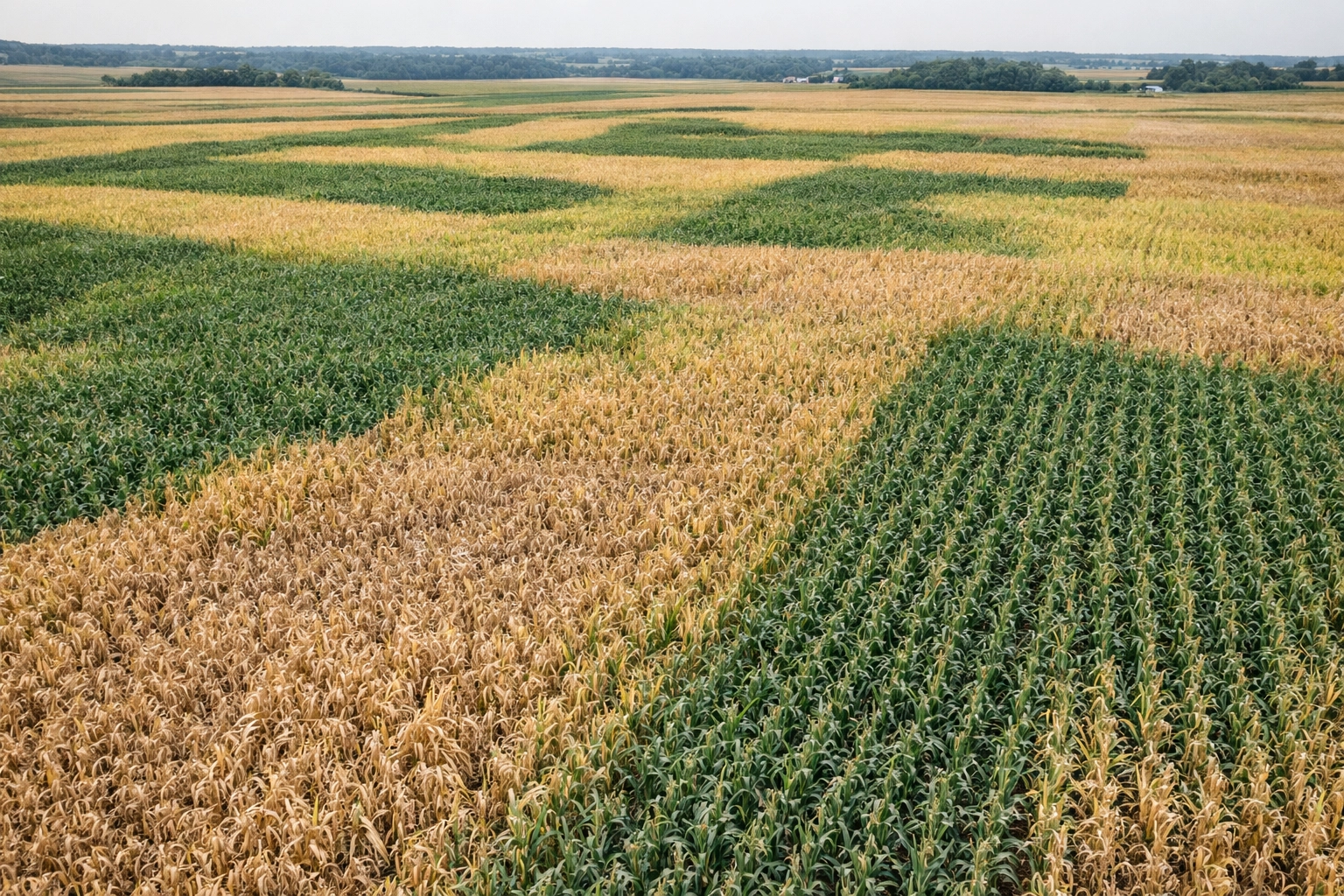
By mid-season, rainfall patterns became fragmented. Some counties received timely moisture, while others slipped into dry spells. July heat added another layer of stress, especially during pollination—the most sensitive stage for corn.
By late summer, crop ratings reflected this unevenness.
According to USDA National Agricultural Statistics Service weekly reports, national corn conditions hovered around 54–57% in “good-to-excellent” during key growth stages. That number suggested stability. But on the ground, farmers saw a much more fractured reality.
“You could have 190-bushel corn next to 150,” Jensen said. “That’s the kind of year it’s been.”
That kind of variability doesn’t average out easily at the farm level—even if it does in national reports.
Across the U.S. Corn Belt, planting decisions are increasingly tied to market signals and policy expectations. As explored in our in-depth Corn Belt field analysis, these choices reflect a complex mix of agronomy, economics, and timing.
Corn Yield Variability Across Midwest States in 2026
As harvest began, yield reports confirmed what farmers had been seeing for months.
- Northern Iowa & Southern Minnesota: Strong yields, often 180–210 bushels per acre
- Central Illinois & Indiana: Mixed fields ranging 150–200 bushels
- Eastern Nebraska: Heat stress areas dipping 140–165 bushels
The national average is expected to land near 180–182 bushels per acre, based on early estimates from the USDA World Agricultural Outlook Board.
But averages don’t tell the full story.
The spread between high-performing and underperforming fields is wider than usual. That means two farmers in the same county may face completely different financial outcomes.
This variability is now a central feature—not an exception—of the 2026 harvest.
Corn Prices 2026: Harvest Pressure and Market Reality
As combines moved deeper into fields, market pressure became unavoidable.
Corn futures softened heading into harvest, with prices settling between $4.20 and $4.60 per bushel during peak harvest weeks. For many operations, breakeven levels sit closer to $4.50–$5.00, depending on land costs and financing structure.
That margin compression is where the tension builds.
According to USDA Economic Research Service cost estimates:
- Fertilizer costs remain 20–30% above long-term averages
- Diesel prices are still elevated compared to pre-2020 levels
- Equipment financing costs have increased alongside interest rates
In earlier seasons, strong yields could compensate for weaker prices. In 2026, that balance is harder to achieve.
A 200-bushel crop may still work financially.
A 155-bushel crop, sold into the same price range, creates pressure almost immediately.
Grain Storage Strategy Becomes Financial Decision in 2026
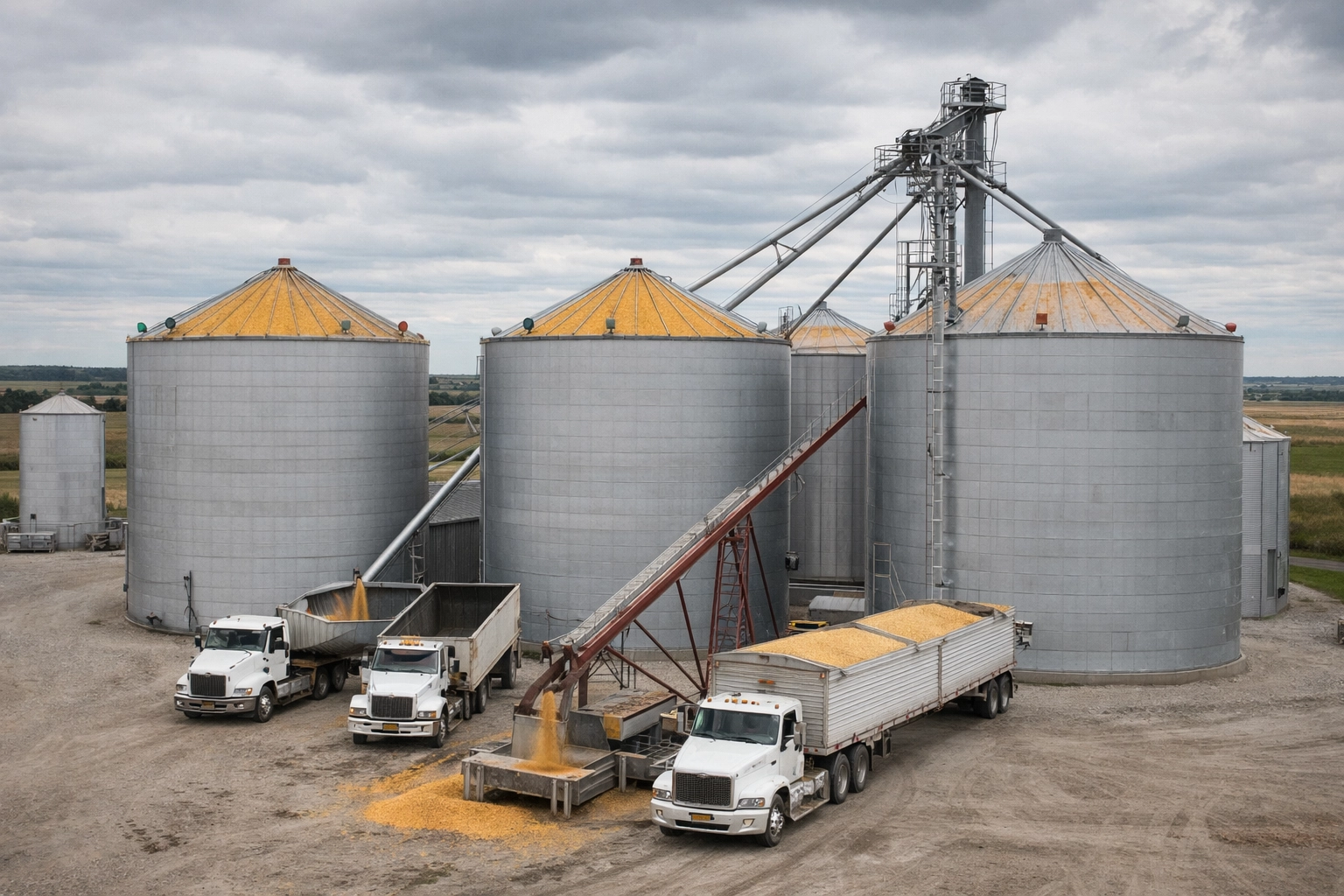
Across Iowa and Illinois, grain bins are filling—but not necessarily emptying.
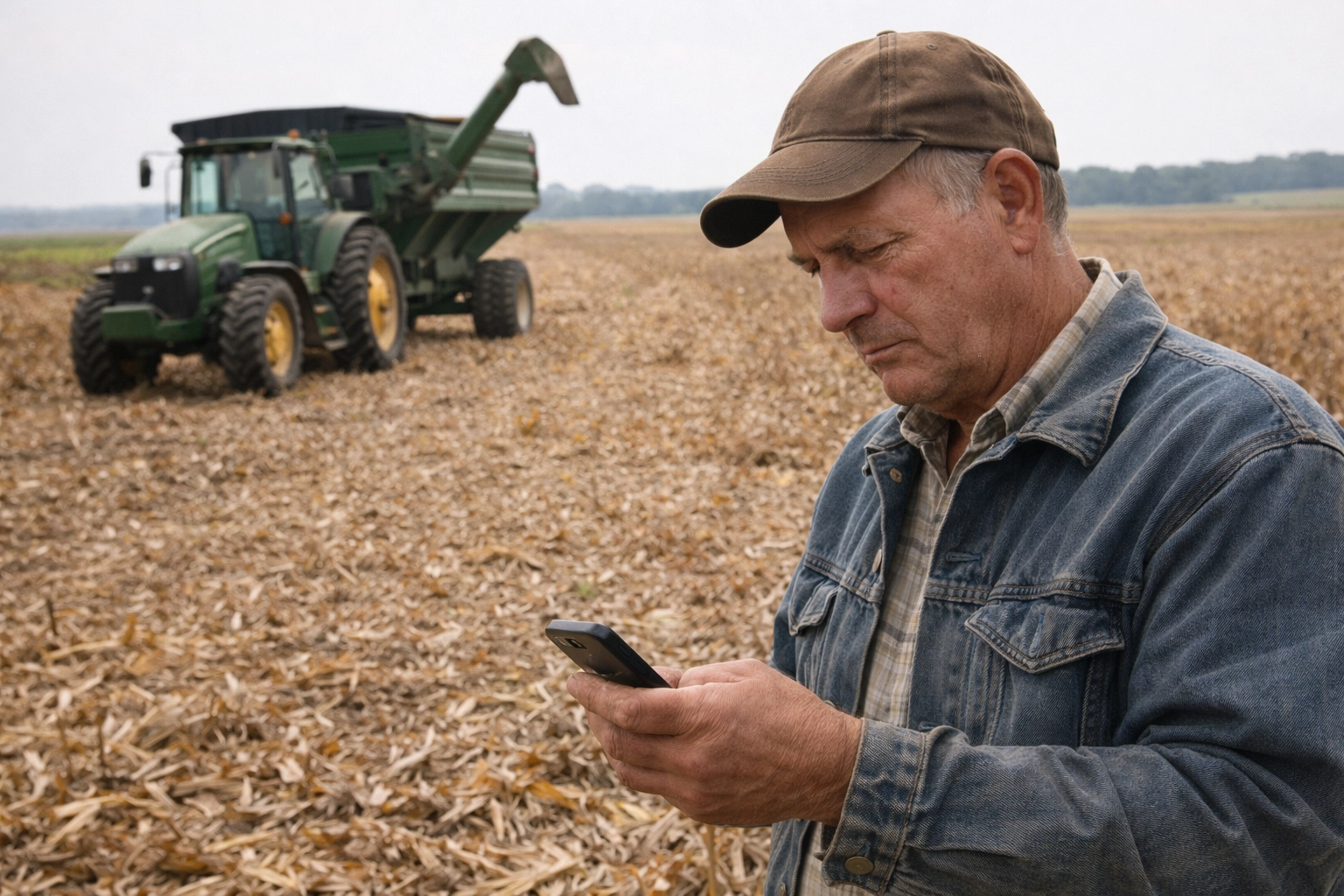
Farmers are holding grain, hoping for post-harvest price improvement. But this year, storage comes with a cost.
Interest rates on operating loans now commonly fall in the 7–9% range, making storage a financial commitment rather than a neutral choice.
According to Federal Reserve Bank of Kansas City agricultural finance surveys, farm loan demand has increased through 2026, while repayment rates show early signs of stress in parts of the Midwest.
“Storage used to give you flexibility,” said a Nebraska lender. “Now it exposes you to risk.”
Farmers are weighing three key factors:
- Current market price vs. expected winter recovery
- Storage and interest cost vs. potential gain
- Immediate cash flow vs. delayed revenue
Each decision carries financial consequences beyond the field.
Midwest Corn Harvest Comparison: 2023 vs 2026
| Factor | 2023 Season | 2026 Season |
|---|---|---|
| Average Yield Range | ~175–180 bu/acre | ~170–185 bu/acre (high variability) |
| Price Range (Harvest) | ~$4.80–$5.20/bu | ~$4.20–$4.60/bu |
| Input Cost Pressure | Elevated, easing | Persistently high |
| Interest Rates | ~5–6% | ~7–9% |
This comparison shows how the system has shifted without collapsing.
Yields are near trend levels—but less consistent. Prices are not dramatically low—but they are tighter relative to costs. And financing has become more expensive.
In 2023, farmers could rely on a more predictable balance. In 2026, that balance is less stable.
The result is a narrower margin for error—and a greater emphasis on decision-making.
Before making planting decisions, it’s important to understand real-world field conditions. A detailed example can be seen in this Midwest corn farmer daily routine, where timing and soil moisture play a critical role.
U.S. Farm Policy and Corn Harvest 2026 Outlook
While harvest moves forward, policy discussions continue in Washington.
The next farm bill remains under negotiation, with attention on:
- Crop insurance support levels
- Commodity reference prices
- Conservation funding
According to projections from the Congressional Budget Office, total agricultural spending is expected to remain relatively stable—but how that support is structured may change.
Crop insurance continues to play a central role.
In a year like 2026, where yield losses are uneven rather than catastrophic, insurance does not fully offset revenue gaps. But it provides enough liquidity to maintain operations.
At the same time, conservation incentives tied to climate-focused practices are beginning to influence long-term farm planning—even if their impact is not yet visible in this harvest.
Global Corn Market Impact on Midwest Farmers
The Midwest harvest is shaped not only by local conditions—but by global supply.
In 2026, Brazil’s expanding corn production continues to influence global pricing. Larger export volumes have increased competition for U.S. grain in international markets.
According to outlook data from the USDA Foreign Agricultural Service:
- U.S. exports remain steady but face stronger competition
- Brazil has gained a larger share of global corn trade
- Price competitiveness is becoming more important than volume
For Midwest farmers, this global dynamic translates directly into local prices.
“You’re doing your job here,” Jensen said. “But the price gets decided somewhere else.”
Even strong domestic demand—from ethanol plants and livestock operations—has not fully insulated U.S. farmers from global pressure.
Operational Stress During Corn Harvest Season
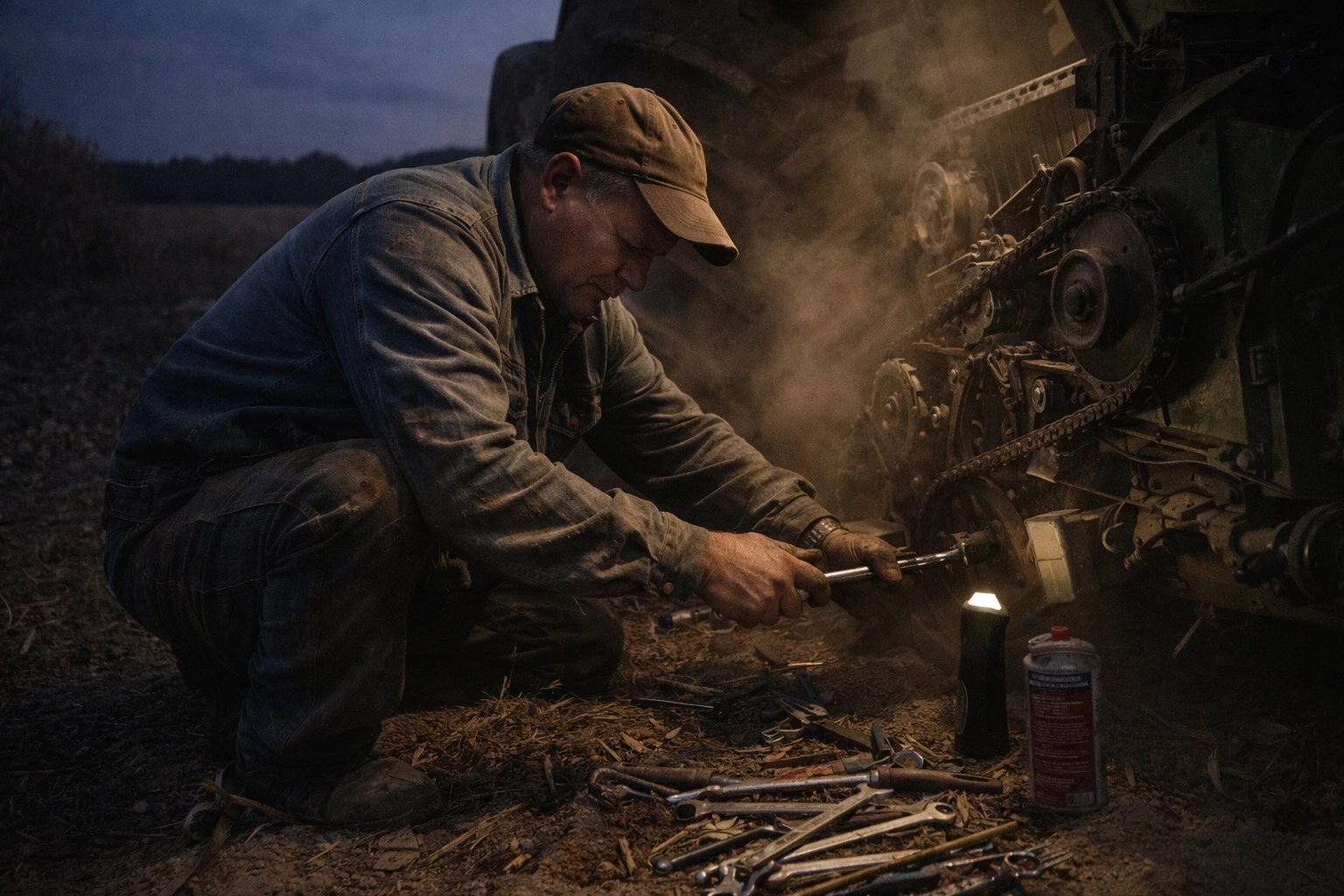
Harvest has always been physically demanding. But in 2026, the mental load is just as significant.
Farmers are constantly navigating decisions:
- Sell now or store?
- Reduce debt or hold cash?
- Invest in equipment or delay spending?
Each choice carries risk.
A farmer in Indiana described checking futures markets as frequently as he checks grain moisture. Another in Nebraska postponed machinery upgrades to maintain liquidity.
This reflects a broader shift.
Farming is no longer just about producing efficiently. It is about managing financial exposure just as carefully as agronomic performance.
Technology and Precision Farming in 2026 Harvest
Technology continues to provide deeper insight into field performance.
Yield monitors and precision tools now show variability at a granular level:
- High zones exceeding 200 bushels per acre
- Mid-range areas around 170–180
- Lower-performing patches below 150
This data helps with long-term planning—but it also reinforces a key reality:
Variability is no longer occasional. It is structural.
Farmers are not just growing crops—they are managing variability within every acre.
While cost pressures and weather risks dominate planning, the real impact becomes visible at the field level. A closer look at a
day in the life of a Midwest corn farmer shows how these decisions translate into action during planting season.
What the 2026 Corn Harvest Means for U.S. Agriculture
As harvest nears completion, its effects extend beyond the farm gate.
Corn remains central to:
- Livestock feed systems
- Ethanol production
- Export markets
A season marked by variability and tighter margins creates ripple effects:
- Feed costs may fluctuate modestly
- Ethanol margins could tighten
- Export competitiveness depends more on pricing efficiency
At the farm level, expectations are shifting.
The focus is not on maximizing profit—but on maintaining stability in uncertain conditions.
Midwest Corn Harvest 2026 Redefines Stability
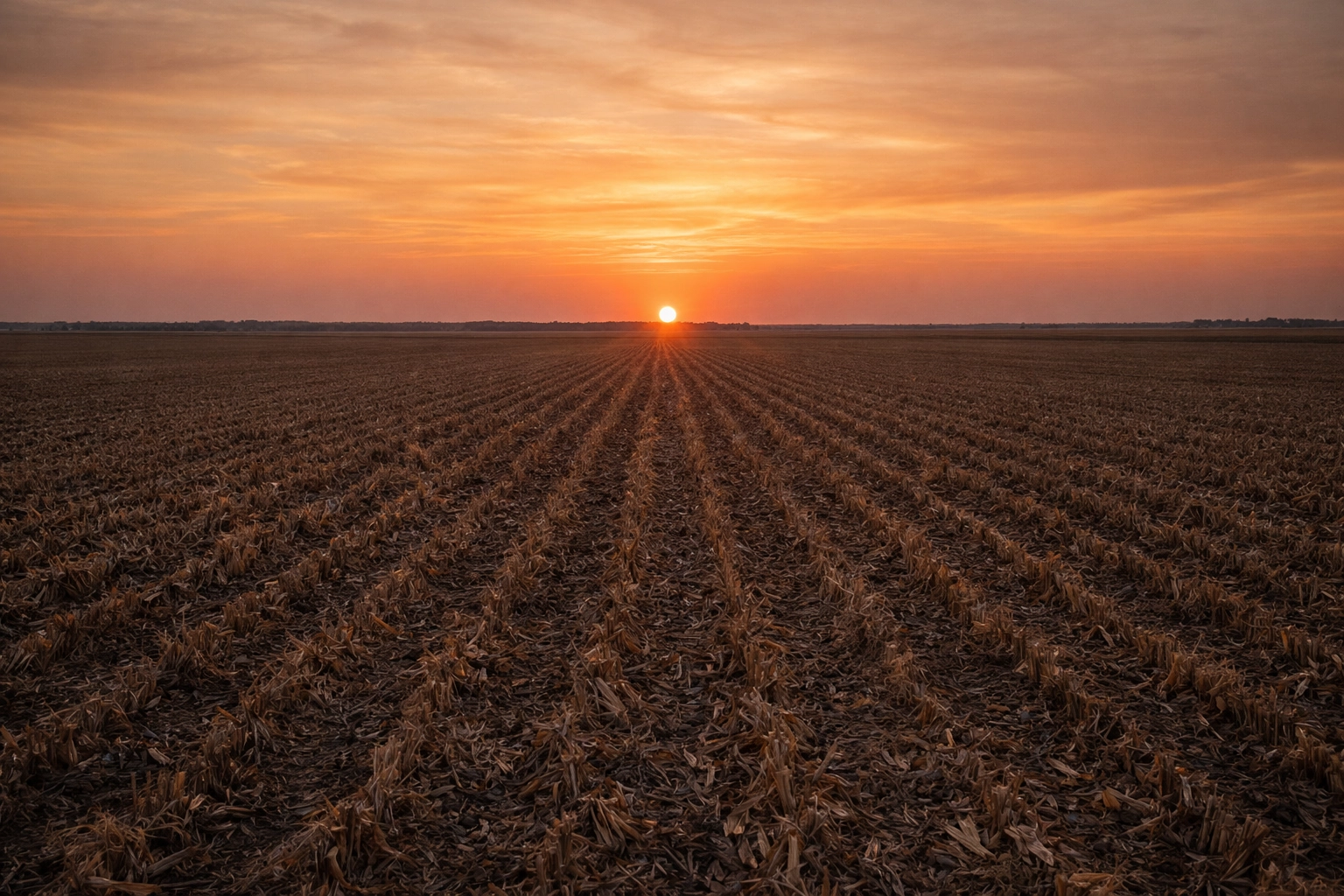
As the last rows are cleared and combines shut down, the 2026 season leaves behind a clear message.
This is not a failed harvest.
It is not even a weak one.
But it is a different kind of year.
Yields are near normal—but less consistent.
Prices are workable—but less forgiving.
Costs are manageable—but still elevated.
“It’s a decent crop,” Jensen said, looking across a finished field. “Just not a comfortable one.”
That distinction defines 2026.
The Midwest corn harvest is no longer shaped by a single factor. It is shaped by the accumulation of many small pressures—weather variability, global competition, cost structure, and financial decisions.
And as farmers begin planning for the next season, one reality stands out:
Stability in U.S. agriculture no longer means predictability.

Written by Janardan Tharkar – an agriculture content researcher and blogging professional with practical experience in farming education, digital publishing, and SEO content optimization. Janardan focuses on modern U.S. agriculture trends, smart farming technologies, irrigation systems, crop development, organic farming practices, and farmer-support programs to create helpful, practical, and trustworthy content for American readers.