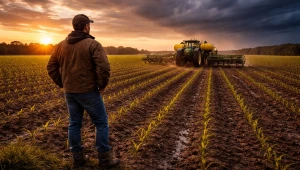
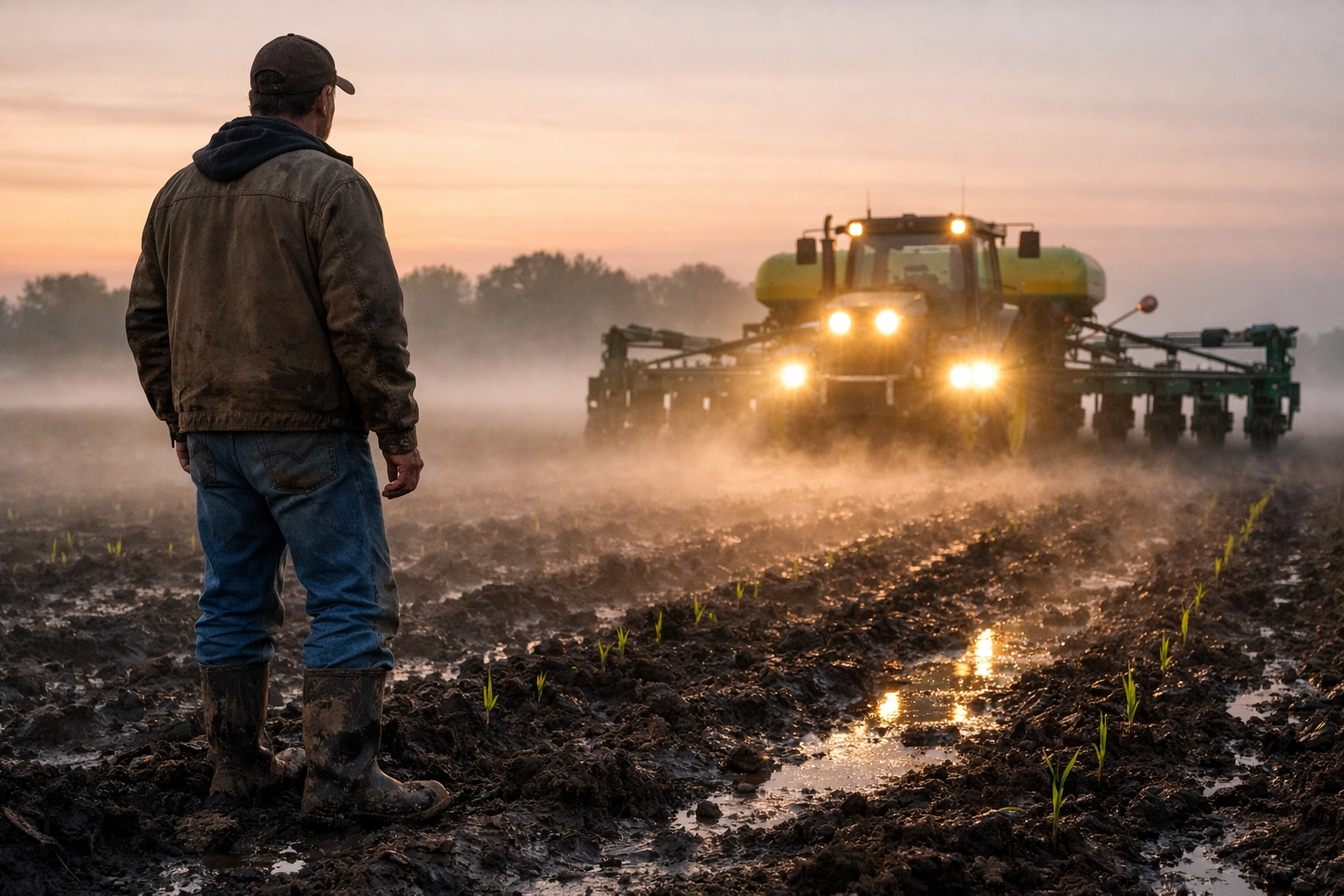
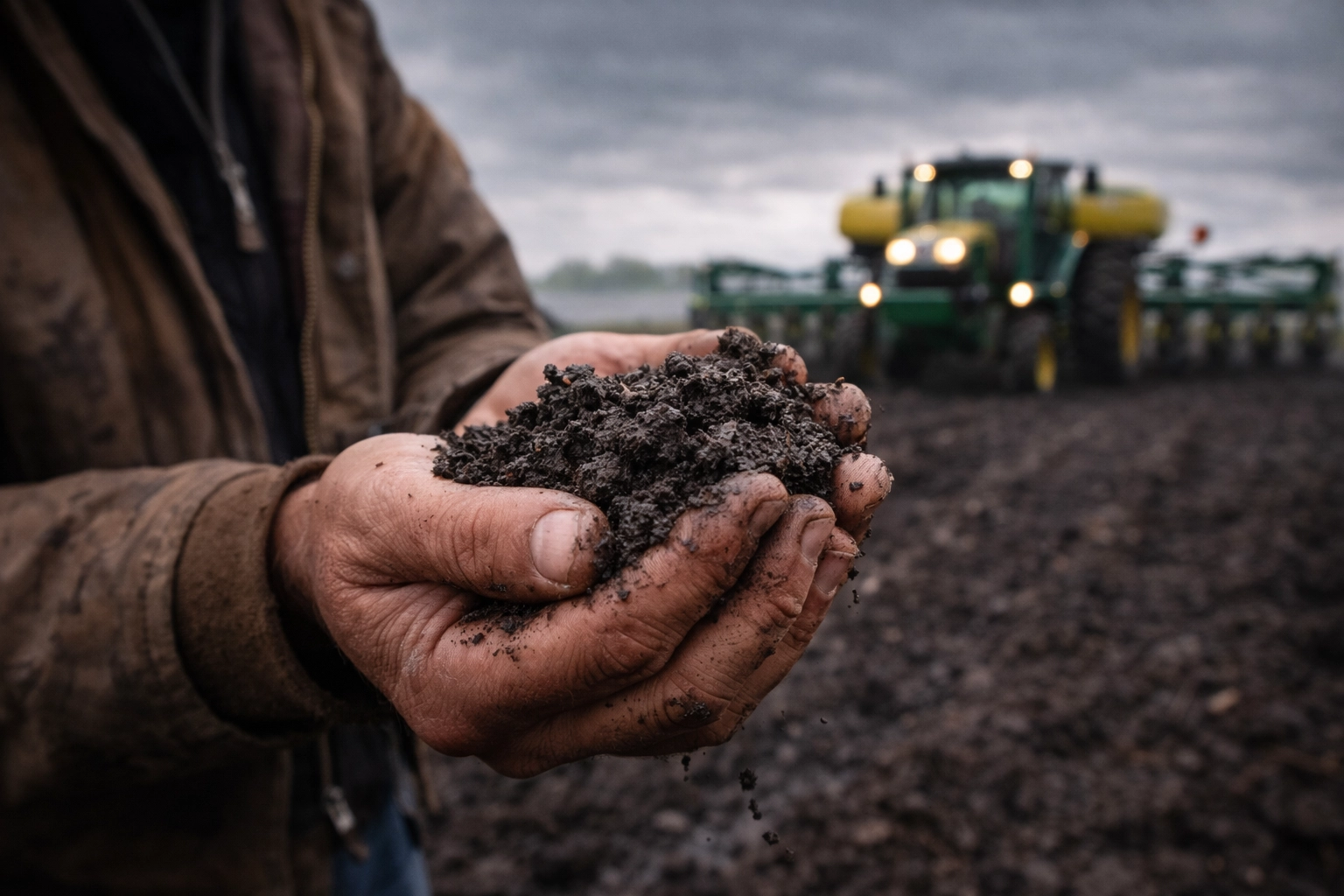
Before sunrise in central Iowa, the air holds a damp chill that clings low over the ground. A planter’s headlights cut through a thin veil of fog, revealing soil that looks ready—but tells a more complicated story underfoot. The top inch crumbles easily. Below that, moisture lingers from a 1.8-inch rain event just five days earlier. A boot sinks half an inch deeper than expected.
Midwest Corn Planting in 2026 doesn’t begin with machinery—it begins with uncertainty.
Before sunrise, farmers step into fields where the topsoil feels ready, but just beneath the surface, moisture still lingers. Every step sinks slightly deeper than expected, raising the same question across thousands of acres: plant now, or wait?
It’s April 18, 2025.
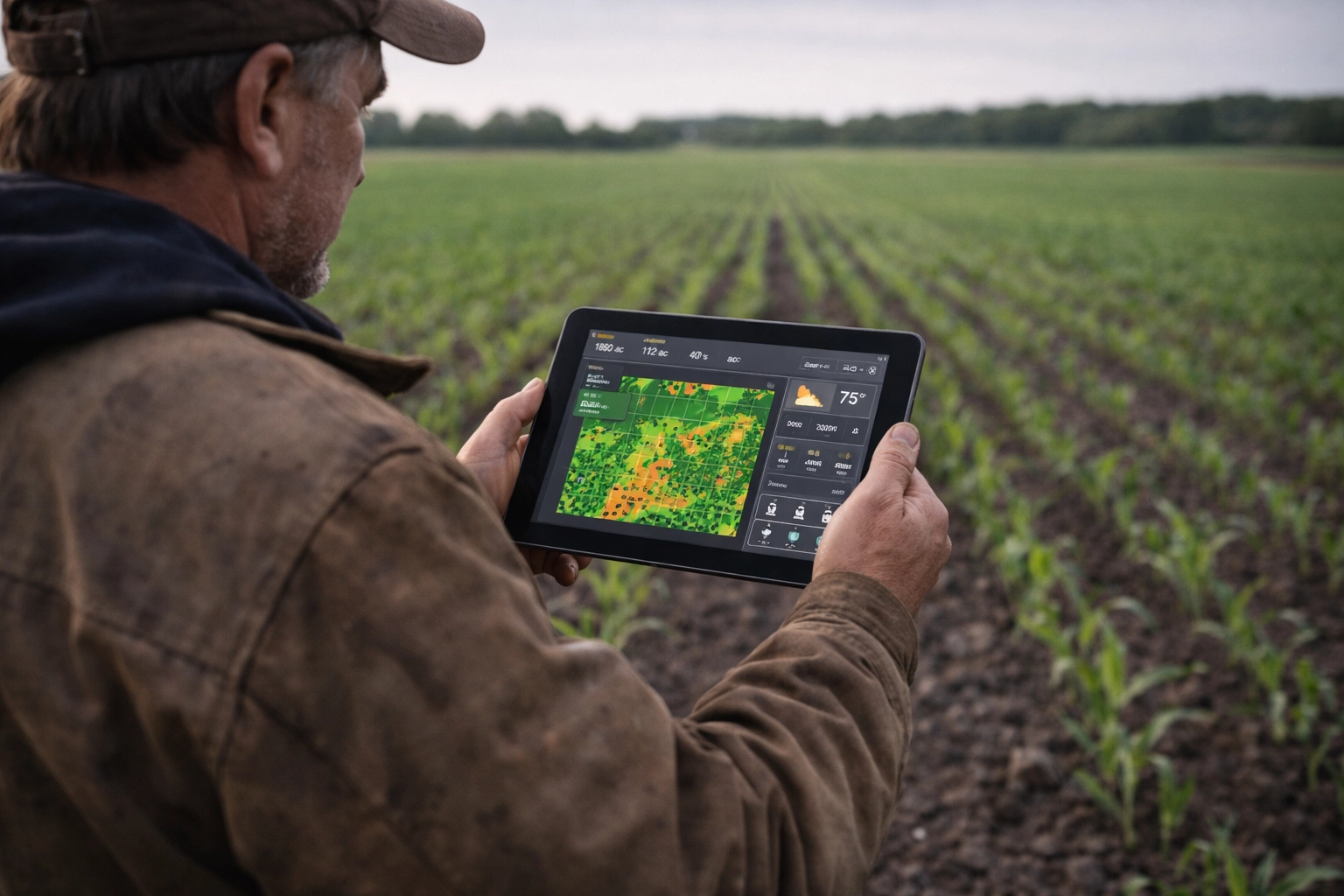
Mark Jensen, a third-generation corn and soybean farmer, stands at the edge of a 400-acre field facing a decision that has become increasingly precise—and increasingly risky:
Plant today into marginal conditions, or wait 48–72 hours and risk losing the early planting window if another 0.5–1.2 inches of rain arrives.
The calendar says planting should already be underway. USDA’s five-year average shows corn planting at ~12–15% complete by mid-April across key Midwest states. This year, progress is uneven—some counties at 20%, others still below 5%.
The sky is clear for now. But the forecast isn’t.
And that uncertainty is where modern farming lives.
Corn Planting Decision 2026: Timing vs Risk
The 2026 planting season is defined not by delays—but by compressed, high-stakes timing decisions.
Corn planted between April 15 and May 5 typically achieves 95–100% yield potential, according to long-term agronomic data. After May 10, yield potential begins to decline—roughly 0.3–0.7% per day, depending on region.
That puts Jensen in a narrowing window.
Option Pressure:
- Plant Now (April 18) → Capture near-optimal yield window
- Delay to April 21–23 → Improve soil conditions but risk rain delays pushing planting into May
This is no longer just agronomy—it’s probability management.
Soil temperature readings this morning:
- Surface: 52°F
- 2-inch depth: 47–49°F overnight lows
Corn germination ideally requires consistent 50°F+ soil temperatures. Dropping below that increases emergence time from 5–7 days to 10–14 days, raising exposure to pests and disease.
Jensen knows the math.
But he also knows the field.
Across the U.S. Corn Belt, planting decisions are increasingly tied to market signals and policy expectations. As explored in our in-depth Corn Belt field analysis, these choices reflect a complex mix of agronomy, economics, and timing.
Soil Moisture Impact on Corn Yield (With Data)
Across the Midwest, soil moisture in April 2026 is not simply “above average”—it’s uneven in measurable ways.
According to recent USDA field condition summaries:
- Northern Iowa: Topsoil moisture rated 68% adequate, 22% surplus
- Southern Minnesota: 74% adequate, 18% surplus
- Illinois: 61% adequate, 9% surplus, 30% short/very short in some pockets
This variability matters because excess moisture increases compaction risk by 15–25%, particularly in heavier soils.
Compaction reduces root depth, which can cut yield by:
- 5–10% in moderate cases
- Up to 20% in severe compaction zones
At the same time, planting into overly wet soil increases:
- Sidewall compaction risk
- Uneven seed depth
- Poor root establishment
But waiting isn’t risk-free either.
A forecast showing even 0.75 inches of additional rain can delay fieldwork by 3–5 days, depending on drainage.
According to USDA NASS crop progress data, years with delayed planting beyond April show:
- Yield variability increases by 12–18%
- Late-planted corn faces higher summer heat exposure during pollination
So the decision isn’t “wet vs dry.”
It’s compaction risk vs delay risk.
Midwest Weather Variability 2026: Regional Breakdown
The defining feature of the 2026 season is intra-regional variability—not just state-to-state differences, but county-to-county divergence.
Rainfall totals over the past 14 days:
- Eastern Nebraska: 2.2–3.1 inches
- Western Iowa: 0.6–1.4 inches
- Central Illinois: 1.0–1.8 inches
Temperature swings:
- Daytime highs: 68–74°F
- Night lows: 34–41°F
That variability creates operational fragmentation:
- Some farms are fully planted by April 20
- Others haven’t started due to soil saturation
This divergence affects markets.
If 70% of the Corn Belt progresses normally, prices remain stable.
If delays push planting beyond May across 30–40% of acreage, markets begin pricing in yield risk.
Farmers track this closely.
Jensen isn’t just watching his soil—he’s watching Iowa, Illinois, Nebraska.
Because his price is shaped by their weather too.
While cost pressures and weather risks dominate planning, the real impact becomes visible at the field level. A closer look at a
day in the life of a Midwest corn farmer shows how these decisions translate into action during planting season.
Corn Price Volatility 2026: Market Pressure on Decisions
Weather risk translates directly into price movement—and in 2026, that movement is measurable.
Corn futures (CBOT) range in early spring:
- $4.35 to $4.95 per bushel (March–April range)
- Intraday swings: 8–15 cents
That’s what “moderate volatility” actually looks like.
For a 200-bushel-per-acre yield:
- A $0.30 price swing = $60 per acre revenue difference
Across 1,000 acres:
- That’s $60,000 in potential revenue variation
At the same time, input costs remain elevated:
According to the USDA Economic Research Service:
- Fertilizer costs: +18% vs 2019 baseline
- Diesel: $3.80–$4.40/gallon range
- Seed costs: $110–$140 per acre
Replanting costs:
- $35–$60 per acre (seed + fuel + labor)
So planting into poor conditions isn’t just risky—it’s expensive.
But delaying planting and losing 5% yield (10 bushels/acre) at $4.50 corn:
- $45 per acre loss
Again—the same structure:
Different risks. Similar consequences.
Crop Insurance & Policy Impact on Planting Decisions
Policy doesn’t make decisions—but it shapes the boundaries.
Crop insurance final planting dates:
- Iowa corn: May 31
- Illinois corn: May 31
- Prevented planting eligibility begins after this
But yield guarantees decline as planting is delayed.
Farmers know:
- Planting late may reduce insured yield coverage
- Prevented planting pays ~55–60% of expected revenue, not full value
According to projections from the Congressional Budget Office, federal farm support remains critical in stabilizing income—but it does not eliminate operational risk.
Meanwhile, regional reports from the Federal Reserve Bank of Kansas City indicate:
- Farm income remains under pressure
- Loan repayment rates tightening in some Midwest districts
So the safety net exists—but it doesn’t remove the need for precise decisions.
Before making planting decisions, it’s important to understand real-world field conditions. A detailed example can be seen in this Midwest corn farmer daily routine, where timing and soil moisture play a critical role.
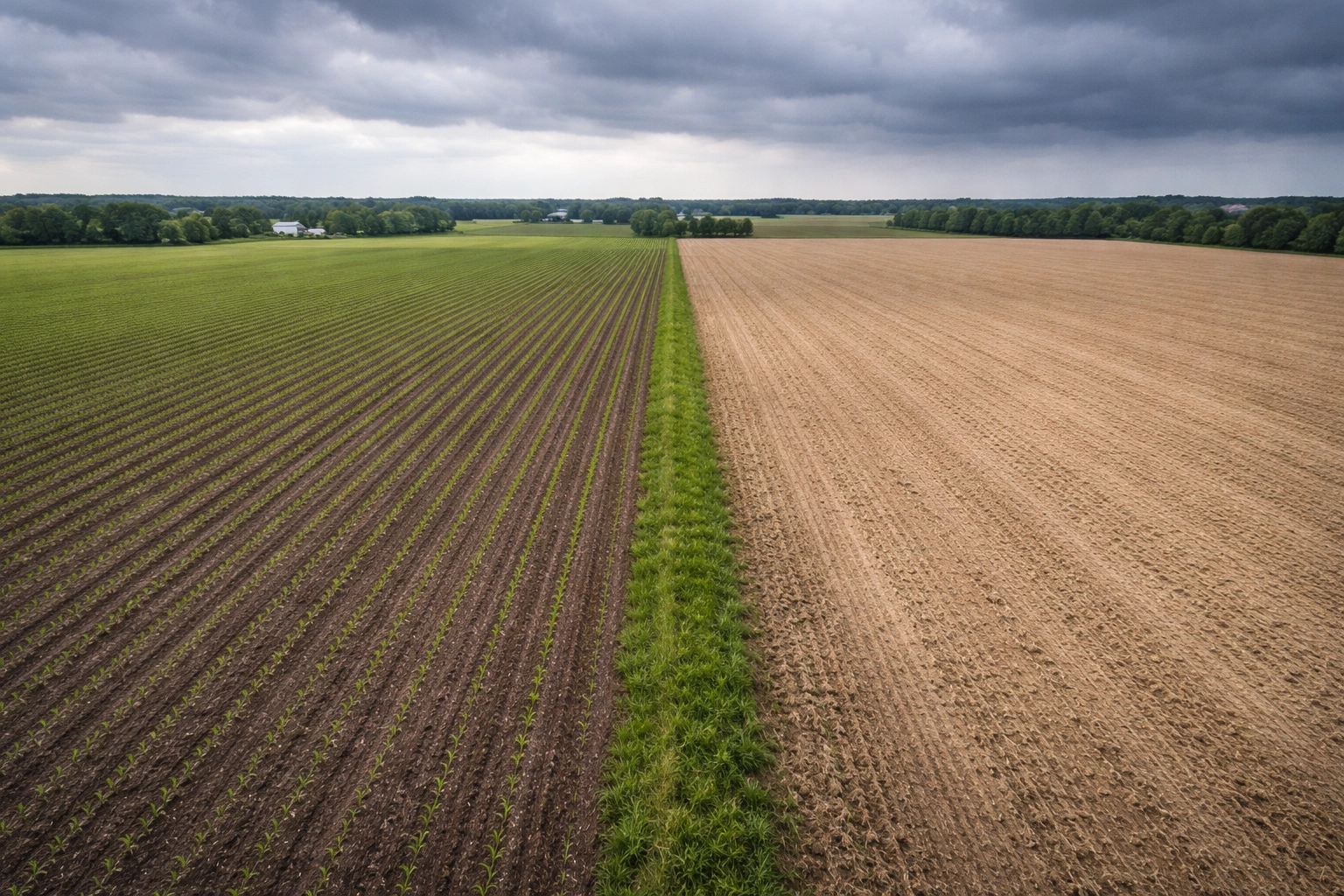
Early vs Delayed Corn Planting: Risk Comparison Table
| Decision Factor | Early Planting (April 15–20) | Delayed Planting (April 21–May 5) |
|---|---|---|
| Soil Condition | 20–30% chance of marginal conditions | 70–85% chance of optimal conditions |
| Emergence Time | 7–14 days (cold variability) | 5–7 days (stable temperatures) |
| Yield Potential | 95–100% | 90–97% |
| Replant Risk | 10–20% probability in wet fields | 3–8% probability |
| Weather Risk | Post-plant cold (30–40°F nights) | Rain delays (0.5–1.5 inch systems) |
| Operational Stress | Lower later season pressure | Higher workload compression |
| Financial Exposure | Replant cost: $35–$60/acre | Yield loss: $20–$60/acre |
What This Comparison Reveals
The table makes one thing clear:
There is no “safe” decision—only risk redistribution.
Early planting concentrates risk at the emergence stage.
Delayed planting shifts risk to the yield stage.
Financially, both scenarios often land in a similar range—but with different timing and uncertainty.
That’s the key shift in modern agriculture:
Farmers are no longer optimizing outcomes.
They are managing risk positioning across time.
Operational Chain Reaction: One Decision, Many Consequences
Planting is just the first domino.
If Jensen plants early and emergence is uneven:
- He may increase seeding rates next year
- Adjust nitrogen timing
- Accept variability in yield zones
If he delays planting:
- He may switch to shorter-season hybrids
- Increase planting speed (raising error risk)
- Face tighter harvest windows in fall
Each decision creates downstream adjustments.
This is why farming in 2026 is not linear—it’s adaptive.
Harvest and Storage Decisions Under Weather Uncertainty
The same pattern continues into harvest.
Consider another trade-off:
- Harvest at 22–25% moisture:
- Drying cost: $0.04–$0.06 per bushel per % moisture
- Total drying cost: $0.20–$0.40 per bushel
- Lower field loss risk
- Wait for field drying (15–18% moisture):
- Lower drying cost
- Higher risk of:
- Wind damage
- Ear drop
- Weather losses (2–8%)
Storage decisions add another layer:
- On-farm storage cost: $0.03–$0.06 per bushel/month
- Basis improvement potential: $0.10–$0.30 per bushel
Again:
Different risks. Same structure.
System-Level Impact: What These Decisions Mean for U.S. Agriculture
When multiplied across millions of acres, these micro-decisions shape national outcomes.
If:
- 25% of corn is planted late → yield drops 2–5% nationally
- That equates to 300–700 million bushels difference
That impacts:
- Export competitiveness
- Ethanol production margins
- Feed costs
But the system is becoming less predictable.
National averages hide:
- Regional losses
- Localized weather damage
- Uneven yield distribution
Markets are adjusting—but slowly.
Farmers adjust faster.
Conclusion: Farming in 2026 Is About Managing Uncertainty, Not Eliminating It
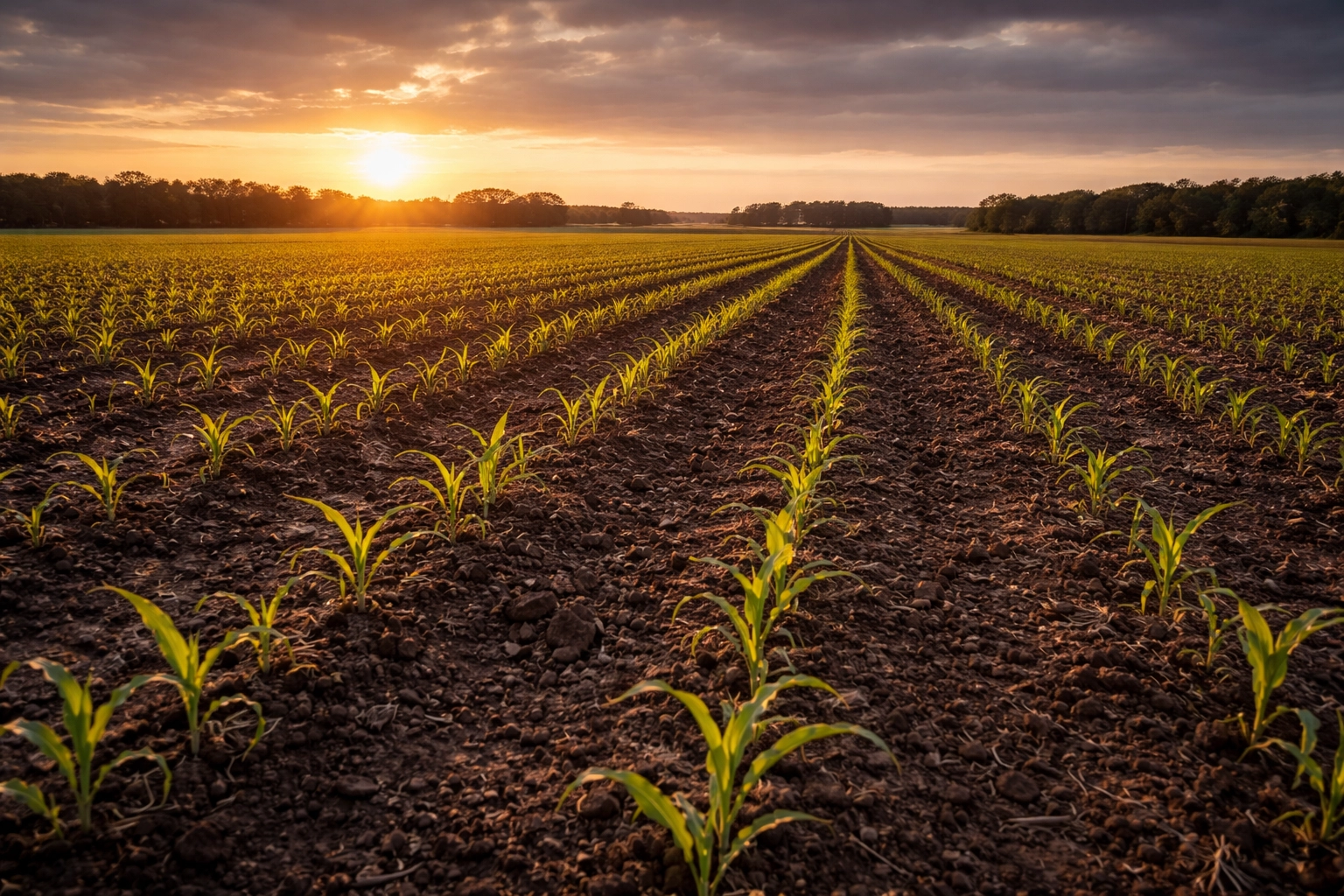
Back in the field, Jensen makes his decision.
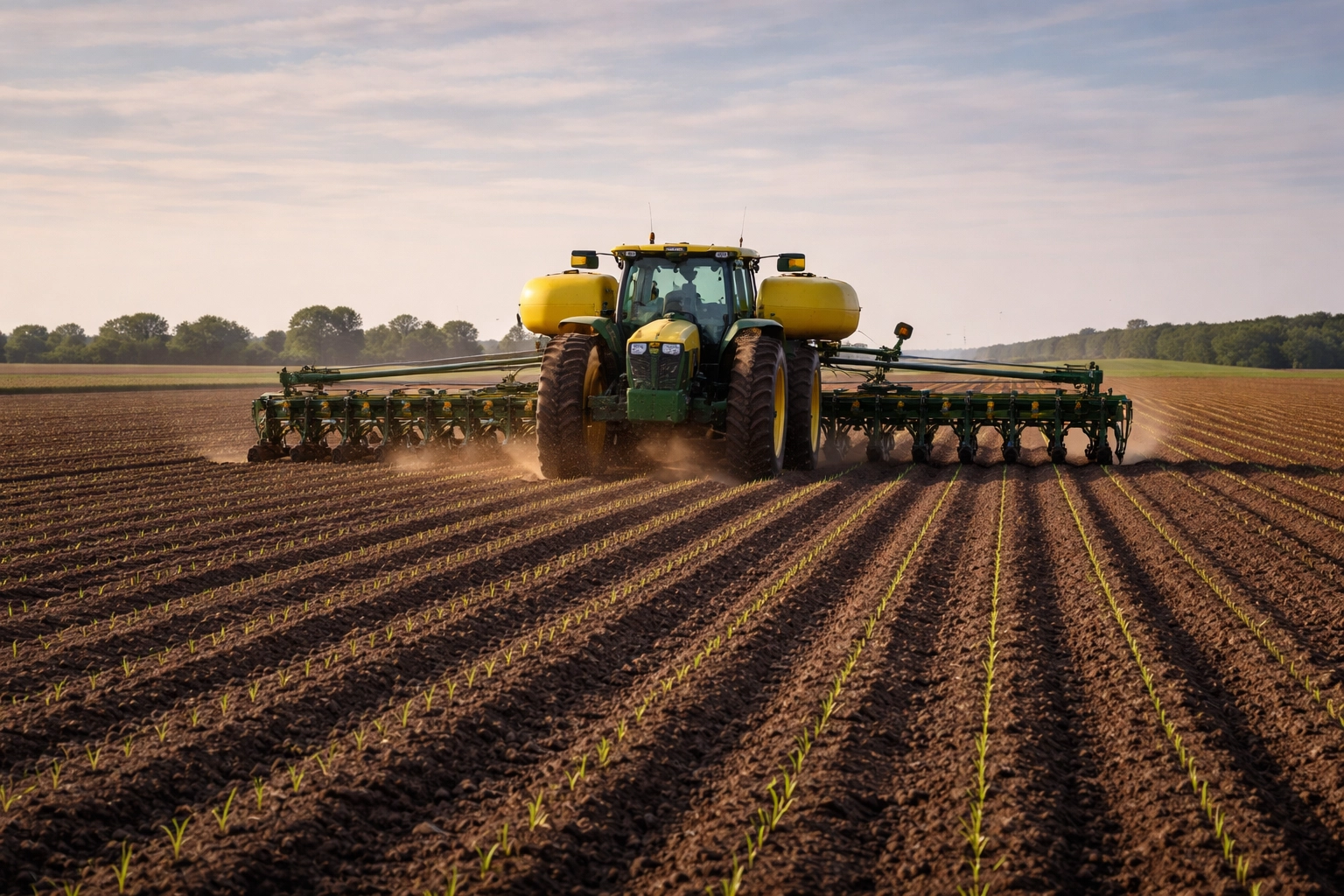
He starts planting.
Not because conditions are perfect—but because waiting introduces a different kind of risk he can’t fully control.
That’s the defining reality of U.S. agriculture in 2026:
- Weather is less predictable
- Decisions are more data-driven
- Risks are more evenly distributed
Farming is no longer about hitting the “right timing.”
It’s about navigating continuous uncertainty with incomplete information.
Every acre planted is a decision under pressure.
Every season is a sequence of trade-offs.
And in fields across the Midwest, the story isn’t just about crops growing.
It’s about decisions unfolding—one row at a time.

Written by Janardan Tharkar – an agriculture content researcher and blogging professional with practical experience in farming education, digital publishing, and SEO content optimization. Janardan focuses on modern U.S. agriculture trends, smart farming technologies, irrigation systems, crop development, organic farming practices, and farmer-support programs to create helpful, practical, and trustworthy content for American readers.