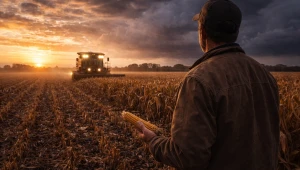
Harvest decisions in modern corn farming don’t begin in the combine—they begin in moments like this.
Before sunrise in late September, the corn leaves in central Illinois carry a dry, papery rustle that cuts through the quiet. The sound of the combine idling nearby adds a low mechanical hum—steady, patient, almost waiting. Headlights stretch across the field, catching rows of tall corn that look ready from a distance but tell a different story up close.
The sky is unsettled. A pale orange band on the horizon pushes against a ceiling of gray clouds drifting in from the west. The air feels still—but not stable.
David Miller stands between two rows, pulling an ear from the stalk. The husk peels back with a crisp snap. Kernels are firm, deep yellow. He twists a few loose, drops them into a handheld tester.
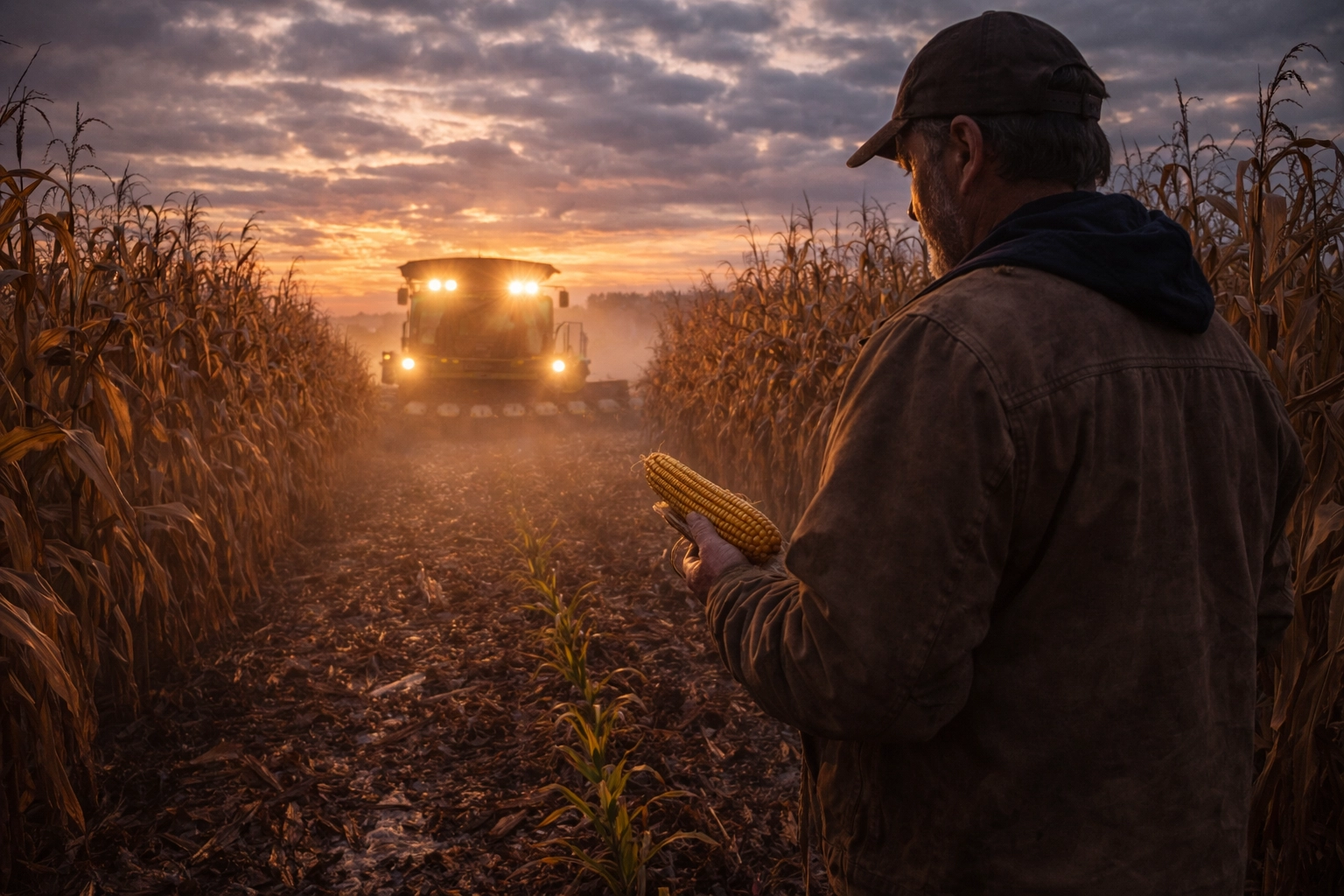
The screen blinks.
22.8% moisture.
Behind him, the combine engine revs slightly as his son checks the header. Everything is ready.
Except the decision.
Why 22% Corn Moisture Is Critical in 2026 Harvest Decisions
In modern corn farming, a number like 22.8% isn’t just a measurement—it’s a trigger point.
Safe long-term storage requires corn moisture around 15%. Anything above that introduces risk:
- Mold development
- Spoilage in bins
- Reduced grain quality
That means every percentage point above 15% carries cost.
At 22.8% moisture, Miller is looking at roughly:
- 7–8 percentage points above safe storage
- Which translates to $0.28–$0.40 per bushel in drying costs
But the decision isn’t purely financial.
Moisture above 20% also means:
- Kernels are less brittle → lower harvest loss
- Stalk integrity is stronger → lower lodging risk
Below 18%, the opposite begins to happen.
So 22% sits in a critical zone:
- Too wet for storage
- But safer for field conditions
That’s why the decision starts here.
Across the U.S. Corn Belt, planting decisions are increasingly tied to market signals and policy expectations. As explored in our in-depth Corn Belt field analysis, these choices reflect a complex mix of agronomy, economics, and timing.
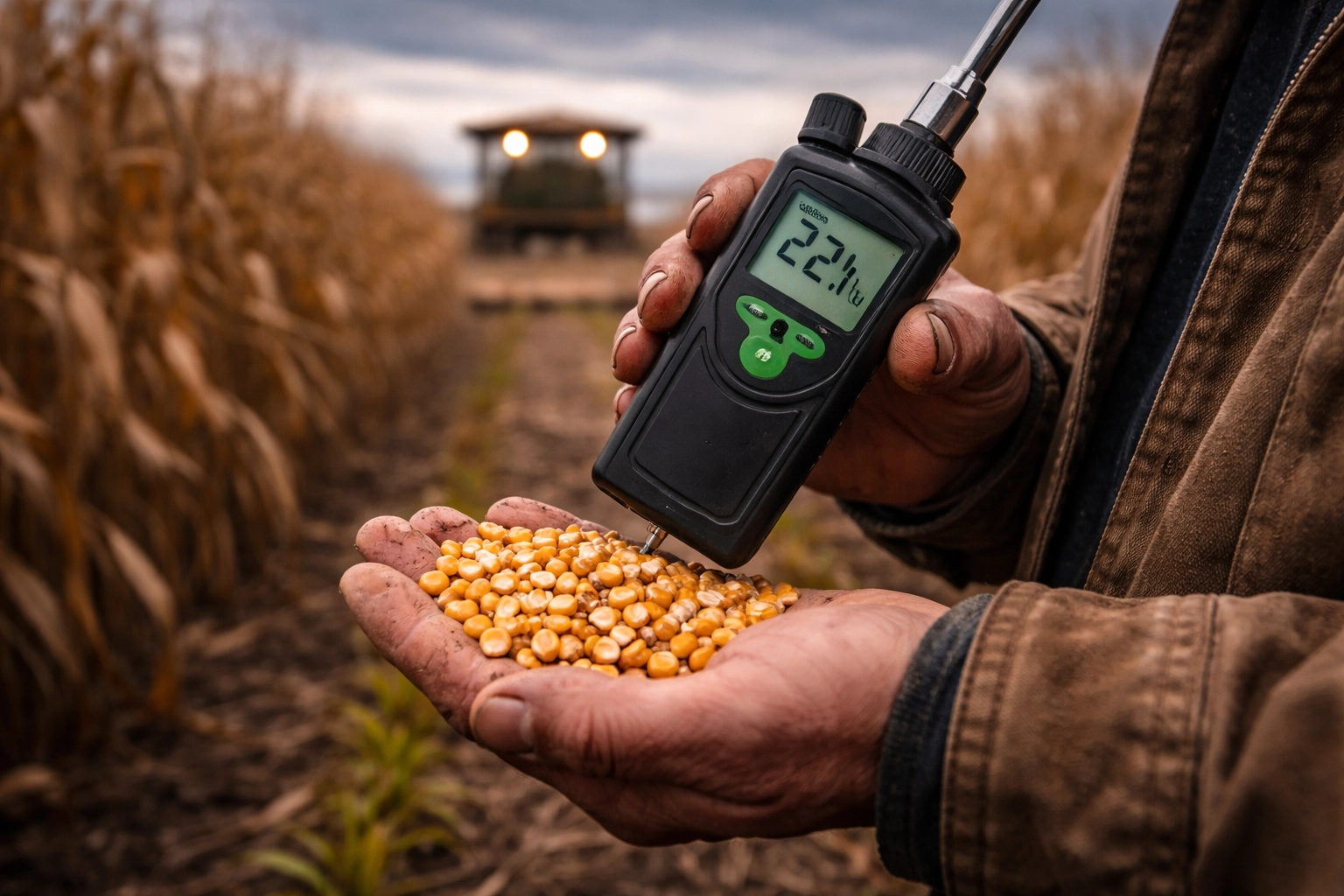
Corn Harvest Decision 2026: High Moisture vs Field Drying Risk
High Moisture Corn Harvest Economics
Harvesting at high moisture is about control.
You take the crop when it’s physically secure and accept the cost of drying.
Typical drying economics in 2026:
- $0.04–$0.06 per bushel per % moisture
- 22% → 15% = ~7 points
- Total drying cost: $0.28–$0.42 per bushel
At 200 bushels per acre:
- $56–$84 per acre
But you lock in:
- Yield
- Quality
- Timing
Field Drying Risk and Timing Trade-offs
Waiting allows natural drying—but introduces uncertainty.
If weather holds:
- Moisture drops 0.5–0.7% per day
- Drying costs decline rapidly
But if weather shifts:
- Rain events of 1–2 inches can reset field conditions
- Wind events increase damage risk
For Miller, the forecast shows:
- 60% chance of rain
- Winds up to 30 mph
That changes everything.
Because waiting is not passive—it’s a calculated exposure.
Corn Drying Cost Breakdown 2026 (Fuel, Energy, and Labor)
Drying isn’t just a line item—it’s a layered cost structure.
1. Propane Cost (Primary Driver)
Most Midwest farms use propane dryers.
- Propane price (2026): $1.60–$2.10 per gallon
- Usage: ~0.018–0.025 gallons per bushel per point
For 7 points removal:
- Total propane cost: $0.18–$0.30 per bushel
2. Electricity Cost
Fans, augers, and drying systems require electricity:
- Cost: $0.02–$0.05 per bushel
3. Labor + Equipment Wear
- Labor: $0.01–$0.03 per bushel
- Equipment depreciation: variable but significant
Total Drying Cost Range:
👉 $0.25–$0.40 per bushel
According to the USDA Economic Research Service, energy costs remain one of the most volatile components of grain handling.
Regional variation matters too:
- Northern Midwest → higher drying demand
- Southern areas → more field drying opportunity
For Miller, drying isn’t just cost—it’s insurance against loss.
While cost pressures and weather risks dominate planning, the real impact becomes visible at the field level. A closer look at a
day in the life of a Midwest corn farmer shows how these decisions translate into action during planting season.
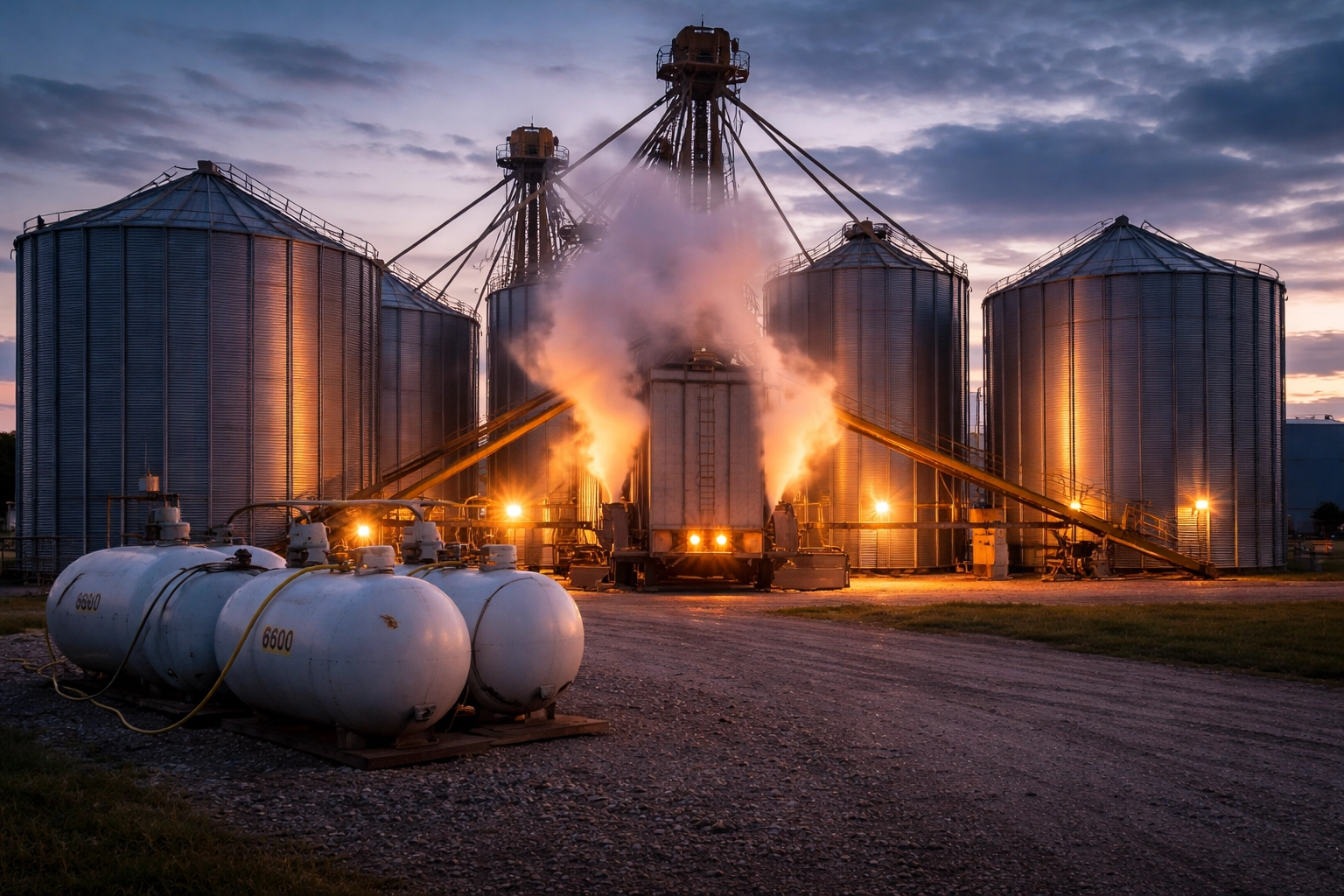
Corn Harvest Weather Risk Impact 2026 (Wind, Lodging, Yield Loss)
Forecasts often understate what farmers actually see.
A 30 mph wind event in a mature cornfield can lead to:
1. Lodging (Plants Falling Over)
- Reduces harvest efficiency
- Increases grain loss
- Can cut yield by 5–12% in affected zones
2. Ear Drop
- Kernels detach from stalk
- Losses: 2–6 bushels per acre
3. Fungal Development
After rain:
- Moist conditions increase risk of:
- Gibberella
- Aspergillus (aflatoxin risk in some regions)
4. Harvest Delays
Wet fields after rain:
- Delay: 3–6 days minimum
According to USDA NASS, late-season weather events are a major contributor to yield variability—even in otherwise strong years.
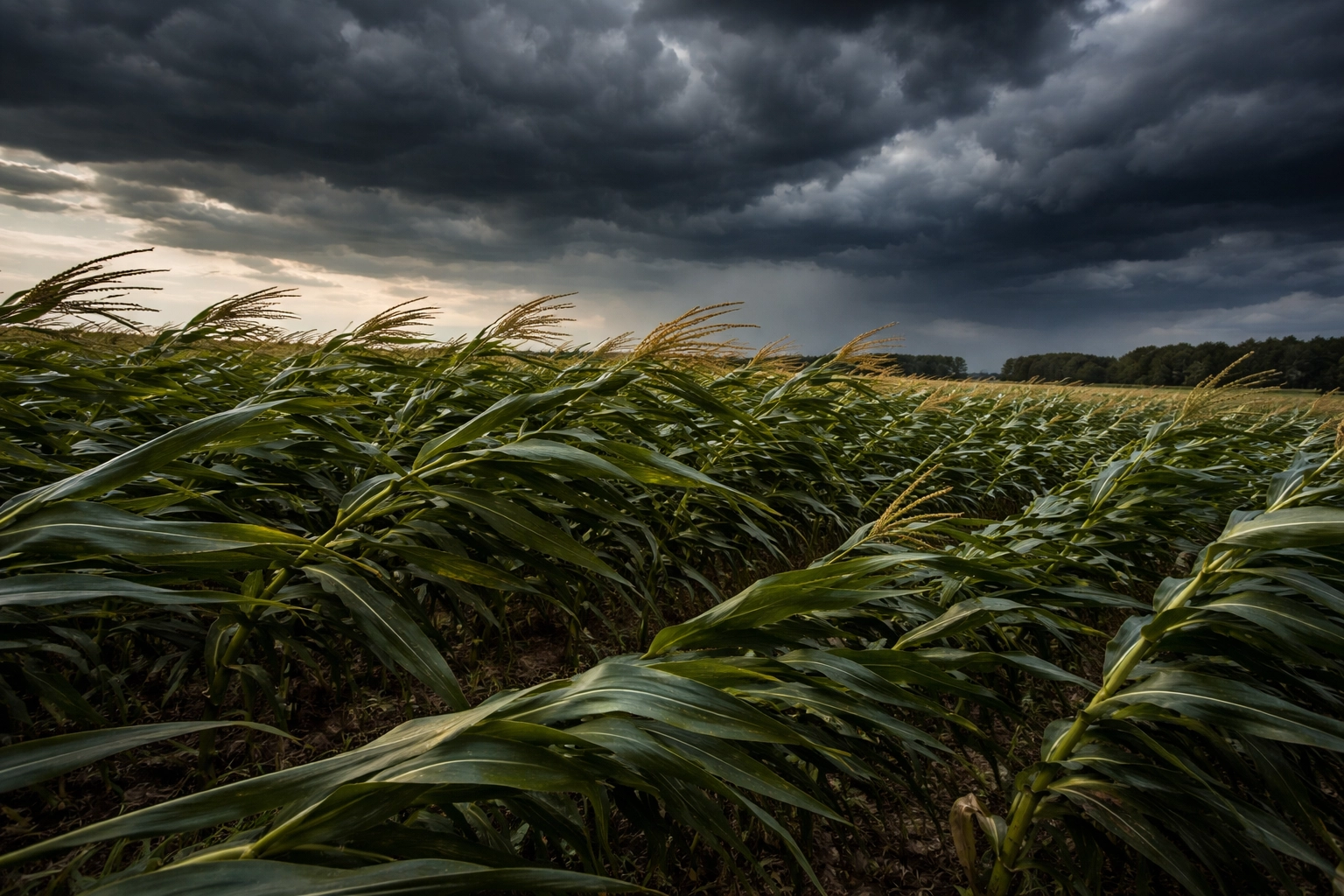
So when Miller sees 30 mph wind, he doesn’t see numbers.
He sees:
- Bent rows
- Lost ears
- Slower harvest
Hidden Work Behind Modern Corn Farming Decisions
What looks like a single decision is actually the result of months of layered planning.
Earlier in the season, Miller made decisions based on:
Growing Degree Units (GDU)
- Hybrid required: ~2,650–2,750 GDUs
- Actual accumulation: slightly behind early, caught up in August
Hybrid Maturity Selection
- Balanced between:
- Yield potential
- Dry-down speed
Stress Timing
- June: Excess moisture → strong vegetative growth
- July: Mild stress during pollination
- August: Ideal grain fill
Each of these factors influences:
- Kernel depth
- Moisture retention
- Dry-down rate
This is the hidden work.
Not visible.
But critical.
USDA Corn Crop Conditions 2026 vs 2025 (Yield and Moisture Trends)
According to USDA NASS crop reports:
2026 Season:
- Good-to-excellent: 65% (national average)
- Illinois: 70%
- Iowa: 60%
2025 Comparison:
- Good-to-excellent: 68% national
- Slightly more uniform conditions
Key difference:
👉 2026 shows more variability, not lower performance
Moisture at harvest:
- 2026: Higher variability (18–25%)
- 2025: More consistent (17–21%)
This matters because:
- Variability increases decision complexity
- Uniform crops are easier to manage
Precision Farming in 2026: Why More Data Means More Decisions
Modern farms generate massive data streams:
- Yield monitors (real-time bushels/acre)
- Soil maps
- Satellite imagery
But limitations remain:
- Satellite data lag: 3–5 days delay
- Yield monitors vary by calibration
- Soil variability within 50–100 feet
Miller sees:
- One zone at 210 bu/acre (24% moisture)
- Another at 180 bu/acre (20% moisture)
Same field.
Different decisions.
As technology improves, farming becomes:
👉 More precise—but not more certain
Before making planting decisions, it’s important to understand real-world field conditions. A detailed example can be seen in this Midwest corn farmer daily routine, where timing and soil moisture play a critical role.
Corn Market Outlook 2026: Storage vs Selling Strategy
Harvest decisions are deeply tied to market behavior.
Price Reality:
- Corn futures: $4.35–$4.75
- Harvest basis: -30 to -50 cents
Post-Harvest Potential:
- Basis improvement: +10 to +25 cents
Storage Economics:
- Cost: $0.04–$0.07 per month
- 3 months: $0.12–$0.21
According to the USDA ERS, profitability depends on:
- Spread between harvest price and later sale
- Storage + interest cost
Farmers may also hedge using futures markets—but that adds complexity.
So Miller must decide:
- Sell now → immediate cash flow
- Store → potential gain, added risk
Farm Policy, Interest Rates, and Financial Pressure in 2026
Financial pressure shapes every operational choice.
According to the Federal Reserve Bank of Kansas City:
- Interest rates on farm loans: 6–8% range
- Loan demand rising in Midwest districts
This affects:
- Storage decisions (carrying cost increases)
- Input financing for next season
Meanwhile, the Congressional Budget Office notes:
- Farm programs remain critical
- But margins remain tight
Insurance helps—but:
- It doesn’t cover price swings
- It doesn’t protect drying costs
So risk remains largely with the farmer.
Corn Harvest Timing Comparison: Harvest Now vs Delay
| Decision Factor | Harvest Now (22–25%) | Delay Harvest (16–20%) |
|---|---|---|
| Drying Cost | High ($0.25–$0.40/bu) | Low |
| Field Loss Risk | Low (1–2%) | Moderate (3–10%) |
| Weather Exposure | Minimal | High |
| Cash Flow | Immediate | Delayed |
| Grain Quality Risk | Low | Moderate |
What This Reveals
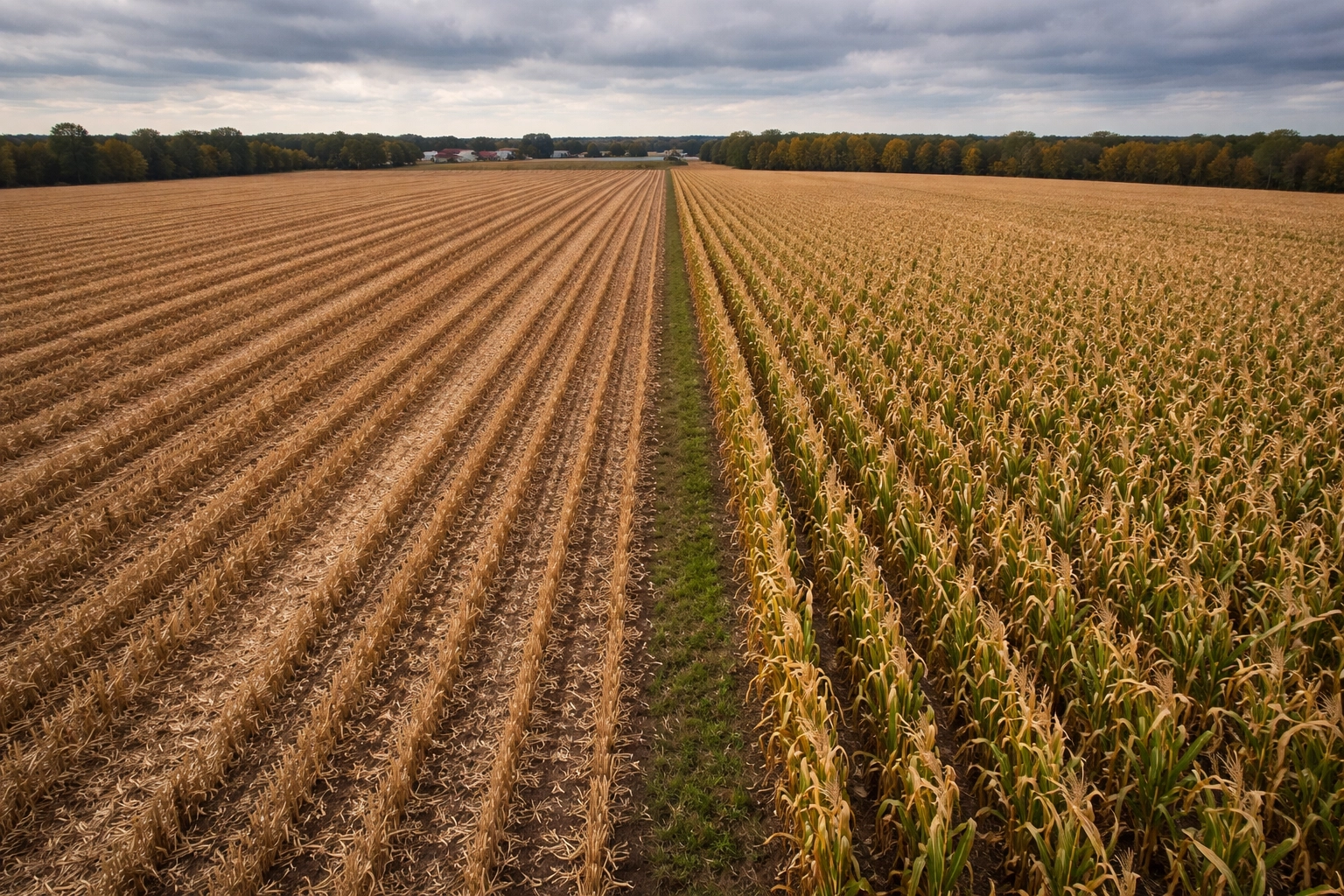
The difference between the two options is not profitability—it’s risk timing.
- Early harvest = upfront cost certainty
- Delayed harvest = deferred risk exposure
Farmers are not choosing profit vs loss.
They are choosing:
👉 Which risk they are willing to carry
Scenario Analysis: Early Harvest vs Delayed Harvest Outcomes
Scenario 1: Harvest Early
- Drying cost: $0.35/bu
- Yield preserved at 200 bu/acre
- Net impact: predictable, stable
Outcome:
👉 Lower profit, lower risk
Scenario 2: Wait 5 Days
- Moisture drops to 18%
- Drying cost falls to $0.12/bu
But:
- Storm hits
- 5% yield loss (10 bu/acre)
Financial result:
- Loss: $46/acre (at $4.60 corn)
Outcome:
👉 Higher potential profit—but fragile
This is the core reality:
👉 Small weather shifts create large financial swings
U.S. Corn Supply Impact 2026: From Farm Decisions to Market Effects
These decisions scale up quickly.
If:
- 20% of farmers harvest early → increased drying demand
- 30% delay → higher field losses
Impact:
- Ethanol supply variability
- Export timing shifts
- Grain logistics strain
A 2% national yield drop:
- ≈ 300 million bushels
That affects:
- Feed costs
- Export competitiveness
Planting decisions in the Midwest are rarely straightforward—they are shaped by soil moisture, timing pressure, and unpredictable weather. This uncertainty becomes even more evident in real field conditions, as shown in a detailed analysis of
real decisions behind Midwest corn planting in 2026, where farmers constantly balance the risk of waiting against the cost of acting too soon.
The Human Side of Farming Decisions Under Uncertainty
What doesn’t show in data:
- The pressure of operating loans
- Family expectations
- Generational responsibility
Miller isn’t just managing a crop.
He’s managing:
- A business
- A legacy
- A future season
The decision isn’t just economic.
It’s personal.
Why Modern Corn Farming Is About Managing Risk, Not Certainty
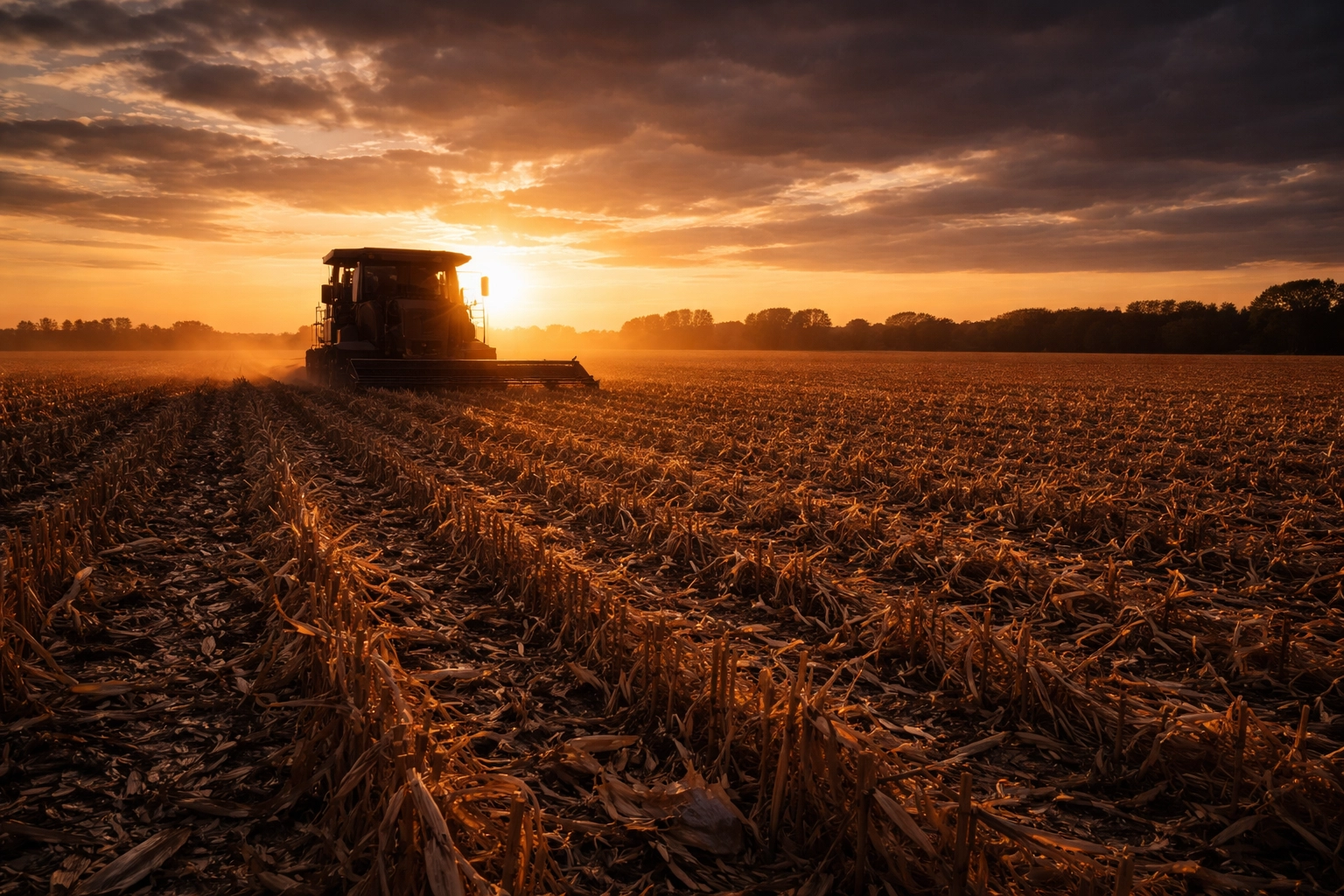
By mid-morning, the combine is moving.
Rows fall.
Grain flows.
The decision has been made.
Not because it was clear—but because it had to be.
That’s modern corn farming in 2026.
Not defined by perfect timing—but by continuous decision-making under uncertainty.
The visible work is machinery.
The real work is judgment.
And that work never stops.

Written by Janardan Tharkar – an agriculture content researcher and blogging professional with practical experience in farming education, digital publishing, and SEO content optimization. Janardan focuses on modern U.S. agriculture trends, smart farming technologies, irrigation systems, crop development, organic farming practices, and farmer-support programs to create helpful, practical, and trustworthy content for American readers.