
Why Every American Farmer Should Care About Who Controls the agriculture money
On a cold February morning in South Dakota, a wheat farmer sits at his kitchen table reviewing last year’s numbers. His crop insurance payout helped him survive a dry season. A conservation payment helped upgrade his irrigation. A USDA loan helped replace aging equipment.
But now he’s wondering something important.
Will those programs still exist next year?
Will funding increase or shrink?
Will new climate rules change how money flows to farms?
Behind every one of those questions is a bigger one:
Who actually decides the US farm budget?
Most farmers hear phrases like:
- “Congress approved funding”
- “USDA announced new programs”
- “The White House released the budget”
But the real decision-making process feels distant, complicated, and political.
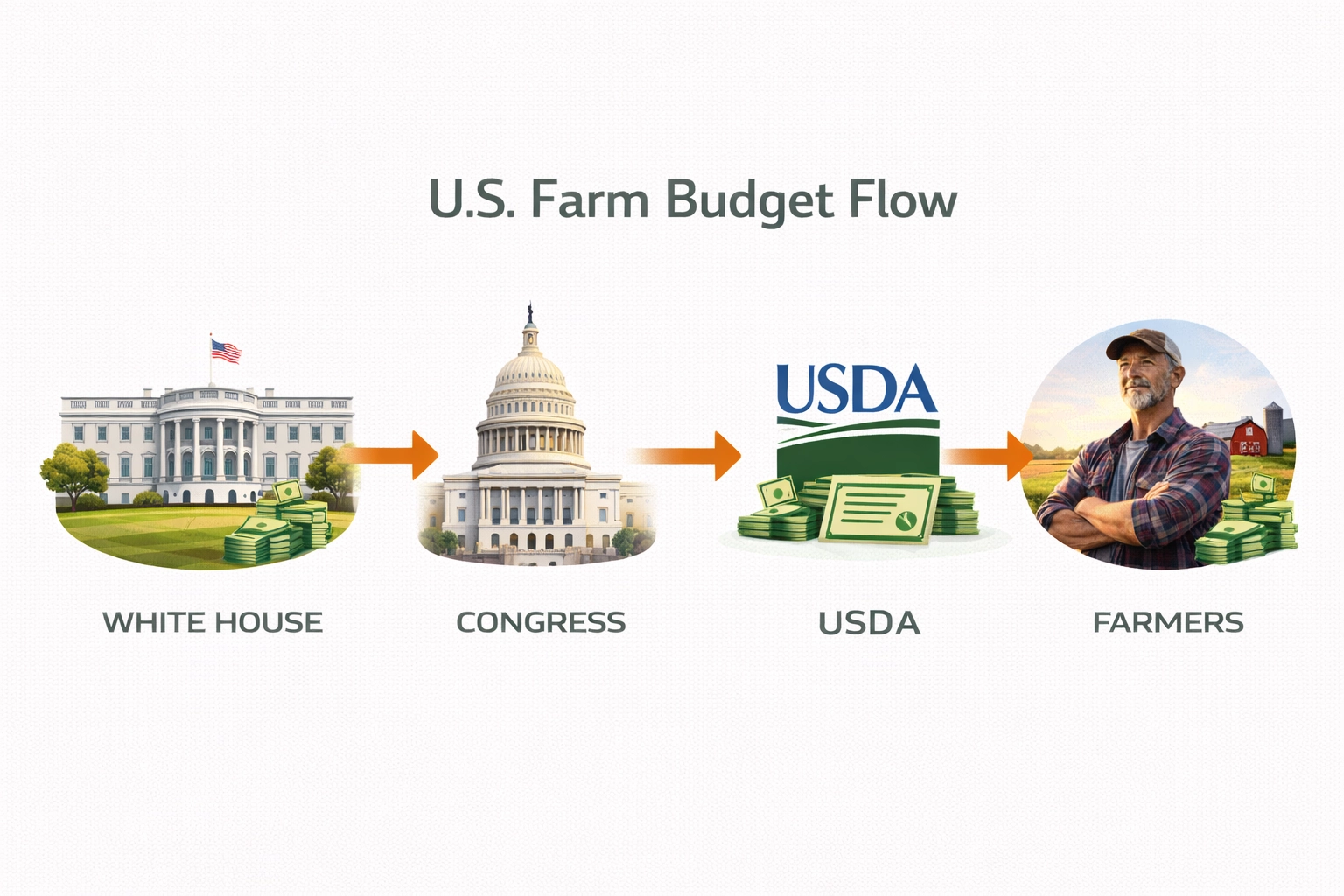
In reality, the US farm budget is shaped by a clear system involving:
- The White House
- The US Congress
- The USDA
And those decisions directly affect:
- Your income
- Your risk protection
- Your access to loans and grants
- Your conservation funding
- Your long-term farm strategy
This guide explains — in simple, practical language — who decides the US farm budget, how the system works, and why understanding it gives farmers and agribusiness owners a real advantage.
What Is the US Farm Budget?
The US farm budget is the portion of the federal budget that funds agriculture, food systems, rural development, conservation, nutrition programs, and agricultural research.
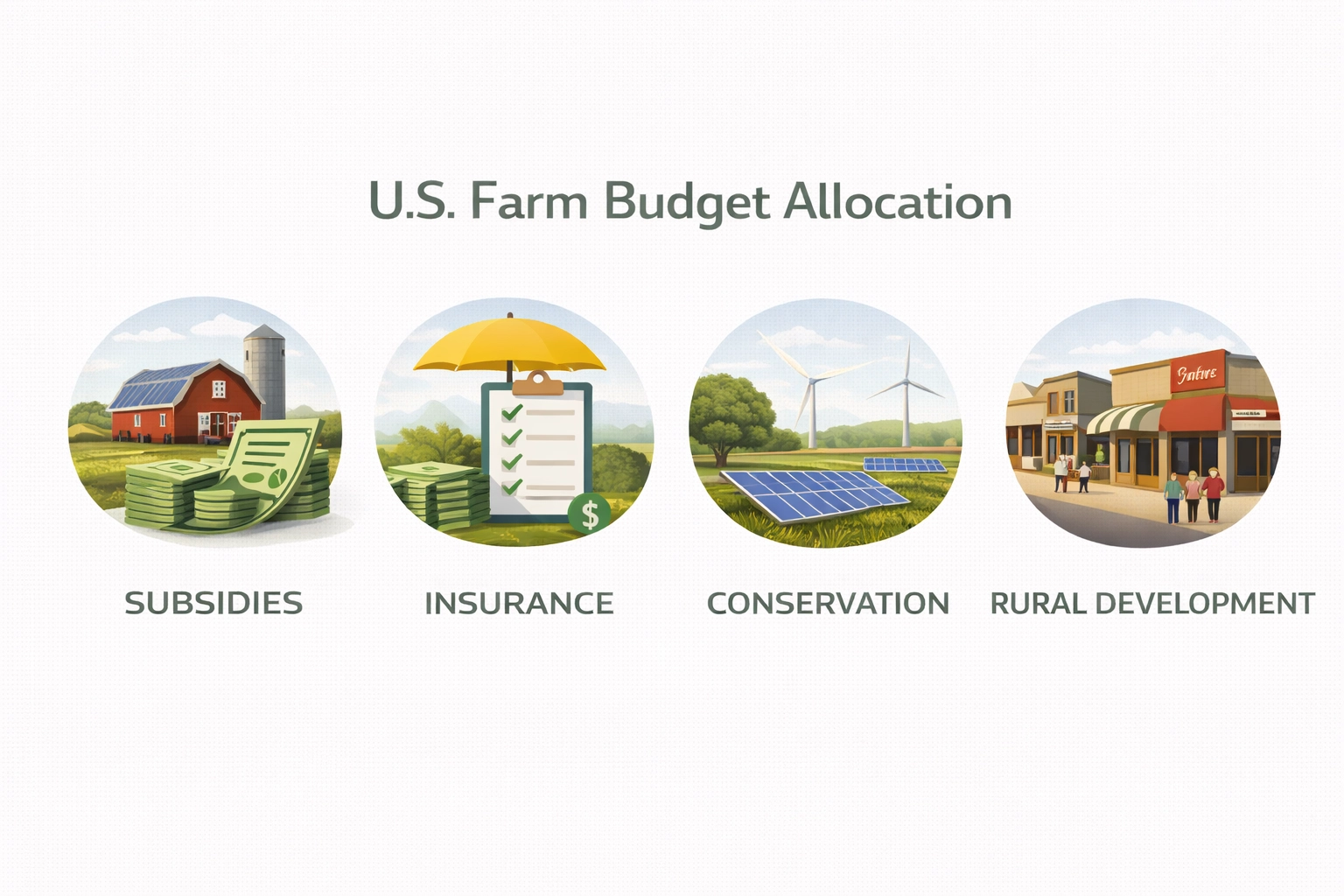
It includes funding for:
- Farm subsidies
- Crop insurance
- Disaster relief
- Conservation programs
- Rural development
- USDA farm loans
- Agricultural research
- Export promotion
- Food assistance
It is managed primarily by the United States Department of Agriculture (USDA) and authorized by Congress.According to USDA, the department’s mission is to support farmers, ranchers, rural communities, food security, and natural resource conservation.
The farm budget is how that mission gets funded.
The Three Power Centers That Decide the US Farm Budget
The US farm budget is not controlled by one office or one politician.
It is shaped by a system of checks and balances involving:
- The White House
- The US Congress
- The USDA
Each plays a different role.
In the United States, rural areas are home to farmers, ranchers, agribusinesses, small manufacturers, energy producers, and nearly 60 million people. Yet rural communities face unique challenges—limited capital, smaller tax bases, infrastructure gaps, and fewer private investors. That’s exactly why Rural Development Programs USA exist.
The White House: Setting National Priorities
The White House does not directly write farm programs — but it sets the direction.
Every year, the President submits a federal budget proposal to Congress. This proposal includes funding recommendations for USDA and agriculture programs.
The proposal is prepared by the Office of Management and Budget (OMB).
Official site:
https://www.whitehouse.gov/omb/
What the White House actually does
The President’s budget proposal outlines:
- Total funding for USDA
- Policy priorities (climate, nutrition, rural development, etc.)
- New program ideas
- Expansion or reduction of existing programs
For example, recent White House budgets have emphasized:
- Climate-smart agriculture
- Renewable energy
- Local food systems
- Rural broadband
- Conservation incentives
The White House budget signals where agriculture policy is heading — even though Congress has final authority.
Why farmers should pay attention
The President’s budget proposal:
- Shapes future Farm Bill negotiations
- Influences USDA program design
- Signals long-term policy trends
- Affects conservation and climate funding
It’s the first draft of the farm budget story.
Congress: The Real Decision-Maker
If the White House proposes, Congress disposes.
Under the US Constitution, only Congress has the power to approve federal spending.
That means Congress ultimately decides:
- How much money agriculture gets
- Which programs are funded
- How long programs run
- What rules apply
According to Congress, all federal spending must be authorized and appropriated by law.
Two Ways Congress Controls the Farm Budget
Congress controls agriculture funding through:
- The Farm Bill (long-term programs)
- Annual Appropriations (yearly spending)
The Farm Bill: The Backbone of the Farm Budget
The Farm Bill is passed roughly every five years.
It authorizes most major farm programs, including:
- Crop insurance
- Commodity programs
- Conservation programs
- Rural development
- Research
- Trade promotion
The Farm Bill sets the rules and funding levels for many years at a time.
Who writes the Farm Bill?
The Farm Bill is written by:
- House Agriculture Committee
- Senate Agriculture Committee
Committee websites:
https://agriculture.house.gov
https://www.agriculture.senate.gov
These committees hold hearings, listen to farmers, consult USDA, and negotiate policy details.
Why the Farm Bill matters so much
The Farm Bill determines:
- Crop insurance subsidy levels
- Farm subsidy programs (PLC, ARC)
- Conservation funding
- Rural development programs
- Beginning farmer support
- Research priorities
It is the long-term foundation of farm policy.
Annual Appropriations: The Yearly Budget
Even with the Farm Bill in place, Congress must approve money every year.
This happens through the Agriculture Appropriations Bill.
It funds:
- USDA operations
- Research agencies
- Rural development programs
- Food safety
- Nutrition assistance
This bill is written by the Appropriations Committees in the House and Senate.
Appropriations Committee:
https://appropriations.house.gov
What appropriations affect
Appropriations determine:
- How much USDA can spend each year
- How fast programs expand
- Whether new programs launch
- Staffing and administration
In short, they turn policy into action.
USDA: Turning Law Into Real Programs
Once Congress passes laws and approves funding, USDA implements them.
USDA does not decide how much money it gets — but it decides how programs operate.
What USDA actually does
USDA:
- Designs program rules
- Runs application systems
- Processes payments
- Manages loans and grants
- Works with farmers directly
Major USDA agencies include:
- Farm Service Agency (FSA)
- Natural Resources Conservation Service (NRCS)
- Rural Development (RD)
- Risk Management Agency (RMA)
- Agricultural Research Service (ARS)
Agency details:
https://www.usda.gov/our-agency
Why USDA matters so much
USDA controls:
- How easy programs are to access
- How fast payments arrive
- How flexible program rules are
- How much technical help farmers get
Good policy means nothing without good implementation.
How the US Farm Budget Is Actually Made (Step-by-Step)
Here’s what happens behind the scenes every year.
Step 1: White House Proposes Budget
The President releases a federal budget request.
This includes proposed funding for USDA and agriculture programs.
Step 2: Congress Reviews the Proposal
Congress:
- Holds hearings
- Reviews USDA requests
- Consults farm groups
- Debates priorities
Step 3: Agriculture Committees Shape Policy
These committees:
- Update Farm Bill programs
- Draft new legislation
- Set long-term rules
Step 4: Appropriations Committees Fund Programs
They:
- Set annual spending levels
- Approve USDA operations budget
- Control research and rural development funding
Step 5: Congress Passes Budget Laws
Both House and Senate must approve bills.
Step 6: President Signs Into Law
The President signs budget and Farm Bill legislation.
Step 7: USDA Implements Programs
USDA:
- Launches programs
- Opens applications
- Distributes funding
This cycle repeats every year.
Where Does the Farm Budget Money Come From?
The farm budget comes from federal tax revenue.
As per Wikipedia, the federal budget is funded primarily through:
- Individual income taxes
- Payroll taxes
- Corporate taxes
Agriculture funding is a small share of total federal spending, but a major driver of rural economies.
In moments like these, most farmers ask one simple question: “What support is really available for us?” That’s where the US agriculture budget comes in.
What Does the Farm Budget Pay For?
Here’s where the money goes.
| Category | What It Funds |
|---|---|
| Crop Insurance | Premium subsidies |
| Farm Subsidies | Income support programs |
| Conservation | Soil & water protection |
| Disaster Aid | Emergency farm relief |
| Rural Development | Business & infrastructure |
| Research | Innovation & productivity |
| Trade | Export promotion |
| Nutrition | Food assistance |
How Farm Budget Decisions Affect Real Farmers
For Small & Family Farms
Budget decisions affect:
- Microloan funding
- Conservation payments
- Disaster assistance
- Beginning farmer programs
If funding shrinks, access becomes harder.
For Commercial Farms
Budget decisions affect:
- Crop insurance subsidies
- Commodity programs
- Export support
- Energy incentives
These programs stabilize large-scale operations.
For Agribusiness
Budget decisions affect:
- Processing plant funding
- Cold storage grants
- Rural logistics
- Export promotion
Rural development funding drives agribusiness growth.
For Rural Communities
Budget decisions affect:
- Broadband access
- Water systems
- Hospitals
- Housing
The farm budget is also a rural development budget.
How Farmers Can Influence the Farm Budget
Many farmers think policy is out of their control.
That’s not true.
Ways farmers influence the budget
- Participate in Farm Bill hearings
- Work with farm organizations
- Meet with members of Congress
- Respond to USDA public comments
- Join producer associations
Farm groups like:
- American Farm Bureau Federation (https://www.fb.org)
- National Farmers Union (https://nfu.org)
regularly influence legislation.
Common Myths About the Farm Budget
Myth: The White House controls farm funding
Truth: Congress controls the money.
Myth: USDA decides how much it gets
Truth: USDA implements what Congress funds.
Myth: The Farm Bill only helps big farms
Truth: It funds conservation, nutrition, and rural development too.
Myth: The budget is fixed
Truth: It changes every year.
USDA farm loan programs are one of the most powerful tools available to American farmers.
Expert Outlook: The Future of the US Farm Budget
Farm policy is entering a new era.
Key trends shaping future budgets
- Climate-smart agriculture
- Carbon and soil programs
- Renewable energy
- Regional food systems
- Precision agriculture
- Rural broadband
What farmers should prepare for
- More conservation-linked funding
- More data reporting
- Stronger sustainability standards
- Greater competition for grants
Strategic advice
Smart farmers will:
- Track Farm Bill negotiations
- Build relationships with USDA offices
- Align with national priorities
- Invest in resilience
Understanding the budget process gives you a real edge.
Frequently Asked Questions
Who has the final say on the US farm budget?
Congress has the final authority. The White House proposes a budget, but only Congress can approve spending.
How often does the Farm Bill change?
Roughly every five years. Congress can extend or revise it as needed.
Can farmers comment on budget decisions?
Yes. USDA regularly seeks public comments on program rules and funding priorities.
Where can I track agriculture budget news?
Follow:
- USDA announcements
- Congress.gov
- Farm organizations
- Agriculture trade publications
Does the farm budget affect food prices?
Yes. It affects production stability, risk protection, and supply chains.
How can I prepare for future budget changes?
Stay informed, diversify income, invest in conservation, and use risk management tools.

Conclusion: Why Understanding the Farm Budget Makes You a Smarter Farmer
The US farm budget is not just politics.
It is the financial foundation of American agriculture.
It decides:
- What programs exist
- How much support farmers receive
- Where rural investment flows
- How food security is protected
And it is shaped by:
- The White House setting priorities
- Congress controlling the money
- USDA running the programs
When farmers understand this system, they stop reacting and start planning.
They use policy as a tool — not a mystery.
Because in modern agriculture, knowledge is just as valuable as land, seed, and equipment

Written by Janardan Tharkar – an agriculture content researcher and blogging professional with practical experience in farming education, digital publishing, and SEO content optimization. Janardan focuses on modern U.S. agriculture trends, smart farming technologies, irrigation systems, crop development, organic farming practices, and farmer-support programs to create helpful, practical, and trustworthy content for American readers.