Before Sunrise in a Wisconsin Barn
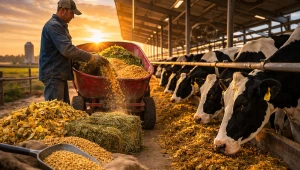
The lights inside the freestall barn outside Marshfield, Wisconsin come on before the sun rises.
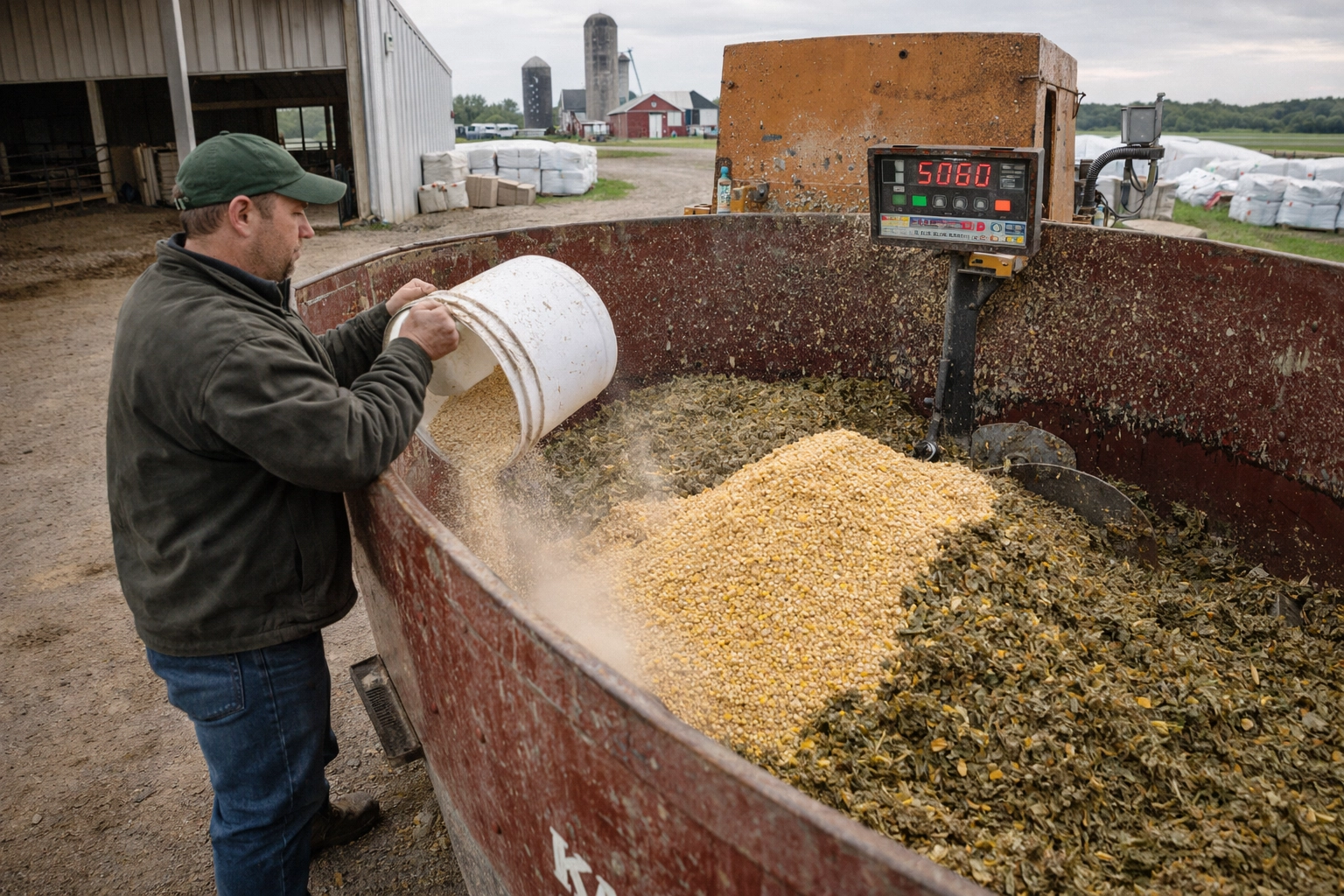
At 4:45 a.m., the feed mixer is already running. Corn silage, alfalfa haylage, soybean meal, and mineral supplements move slowly through the rotating auger. The ration wagon rolls down the feed alley while cows begin gathering along the bunk.
Standing beside the mixer scale is Mark Jensen, a second-generation dairy farmer managing about 420 Holsteins.
He watches the digital numbers carefully before unloading the first batch.
“It only takes a small change to see it in the milk tank,” Jensen says. “Protein drops a little, milk drops a little.”
That tension—between precise nutritional targets and everyday farm reality—has become central to dairy management in 2026.
Daily nutrient requirements for dairy cows are no longer just textbook guidelines. They shape real operational decisions made twice every day on farms across the United States.
How much protein to include.
Whether forage quality has shifted.
Whether feed costs allow another pound of soybean meal.
For farmers like Jensen, those calculations determine whether milk production rises, stalls, or quietly declines over the coming weeks.
And those farm-level choices eventually shape the national milk supply.

The Modern Dairy Cow Is More Productive Than Ever
The dairy cows standing at Jensen’s feed bunk today represent decades of genetic progress.
Thirty years ago, American dairy cows produced significantly less milk than they do today. Improvements in breeding, herd management, and nutrition have dramatically increased productivity.
According to data from the United States Department of Agriculture, average milk production per cow has steadily climbed as dairy genetics and management practices improved. National production statistics tracked by USDA’s National Agricultural Statistics Service illustrate the long-term trend:
https://www.nass.usda.gov/Statistics_by_Subject/result.php?sector=ANIMALS%20%26%20PRODUCTS&group=DAIRY
The result is a very different animal than farmers managed in the early 1990s.
Modern dairy cows produce more milk—but they also require more precise nutrition to sustain that output.
A high-producing Holstein cow in 2026 typically requires:
- Dry matter intake: 50–60 pounds daily
- Crude protein: roughly 16–18% of the ration
- Net energy for lactation: around 1.6–1.7 Mcal per pound
- Neutral detergent fiber: 28–32%
- Calcium: about 0.8% of dry matter
Missing those targets by even small margins can have noticeable effects.
Too little energy reduces milk production.
Too little fiber can upset rumen function.
Too much protein raises feed costs and increases nitrogen waste.
The cow itself operates close to biological limits.
“Today’s cows are amazing producers,” Jensen says. “But they need the ration right every day.”
Read Also
How AI and Sensors Are Transforming U.S. Dairy Farms in 2026
From wearable cow sensors to real-time farm data, learn how AI technology is transforming modern dairy farming across the United States.
Chart: U.S. Milk Production Growth per Cow
To understand why nutrition precision has become so critical, it helps to look at how dramatically milk production has increased over time.
Average U.S. Milk Production Per Cow
| Year | Average Milk Production per Cow |
|---|---|
| 1990 | ~15,000 pounds/year |
| 2000 | ~18,200 pounds/year |
| 2010 | ~21,000 pounds/year |
| 2020 | ~23,800 pounds/year |
| 2026 | ~24,500+ pounds/year (estimated trend) |
This steady increase reflects improvements in genetics, feed formulation, and herd management.
But higher production also raises the stakes for nutrition planning. A cow producing 24,000 pounds of milk annually requires far more energy and protein than one producing 15,000 pounds.
That is why nutrition has become one of the most carefully managed aspects of modern dairy farming.
A Real Farm Case Study: Adjusting the Protein Balance
Mark Jensen’s farm provides a practical example of how those nutritional targets translate into daily management decisions.
Like many Midwestern dairies, Jensen grows much of his own feed—corn silage and alfalfa—but still purchases soybean meal and mineral supplements.
In 2024 and 2025, rising global feed costs pushed soybean meal prices significantly higher.
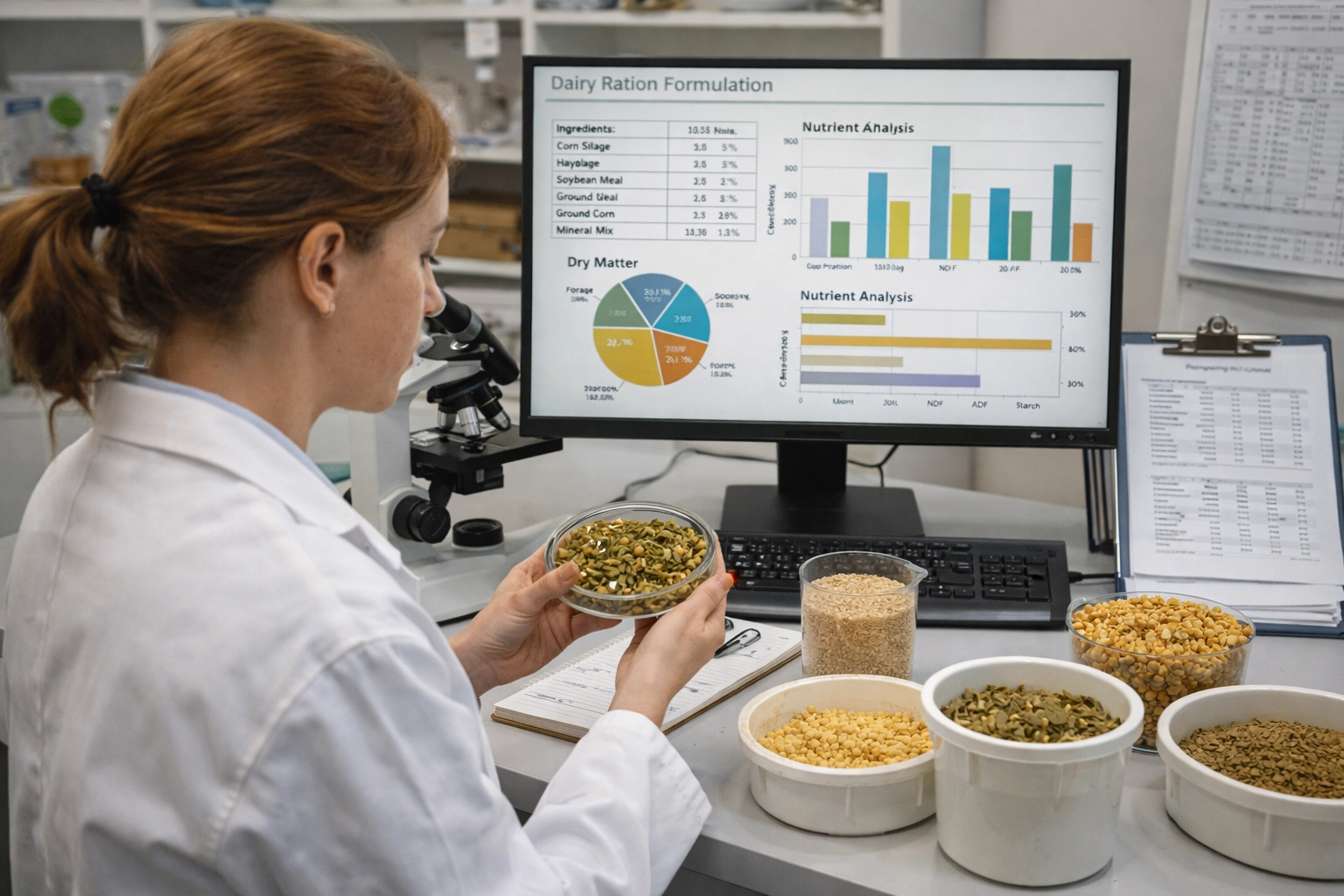
That forced Jensen and his nutritionist to reconsider the protein content in the herd’s ration.
“We dropped crude protein about half a percent,” Jensen explains.
The adjustment may sound small, but it required careful reformulation.
To maintain milk production, they added rumen-protected amino acids and slightly increased energy density through corn grain.
The outcome surprised Jensen.
Milk production stayed stable.
Feed costs declined slightly.
Nitrogen levels in manure decreased.
“It showed us we could be more precise,” he says.
That experience reflects a growing trend across the U.S. dairy sector—precision feeding, where rations are fine-tuned to meet exact nutrient needs without excess.
Feed Costs Still Control the Equation
While nutrition science defines what cows need, economics often determines what farmers can afford to feed.
Feed typically represents the largest expense in dairy production.
In many operations, feed costs account for 50–60 percent of total operating expenses.
Economic research from the USDA Economic Research Service consistently identifies feed prices as the largest driver of dairy farm profitability. ERS dairy market reports regularly analyze this relationship between feed costs and milk income:
https://www.ers.usda.gov/topics/animal-products/dairy/
When corn prices rise, ration energy becomes more expensive.
When soybean meal prices rise, protein becomes costly.
Farmers respond by adjusting feed formulations.
But those adjustments must be made carefully.
“If you cut the wrong thing, milk drops,” Jensen says.
That constant balancing act between biology and economics defines daily ration management on dairy farms.
Also Read

AI and Automation Are Reshaping U.S. Agriculture in 2026
Artificial intelligence and automation are rapidly transforming American agriculture. From precision spraying to autonomous machinery and data-driven crop management, new technologies are helping farmers improve efficiency while facing rising labor shortages and production costs.
Environmental Pressures Are Changing Feeding Strategies
Nutrient management is no longer just a productivity issue.
It has become an environmental one.
Excess nitrogen and phosphorus in manure can contribute to water quality problems if not managed properly.
Because of this, regulators increasingly expect dairy farms to demonstrate efficient nutrient use.
Research programs supported by the USDA Agricultural Research Service focus on improving feed efficiency so cows convert more nutrients into milk rather than waste. Current livestock nutrition research initiatives can be reviewed here:
https://www.ars.usda.gov/research/programs/
Precision feeding plays a key role.
Reducing excess protein in rations lowers nitrogen excretion and improves environmental outcomes.
But farmers must avoid cutting nutrients too aggressively.
“If milk drops even a little, that hurts,” Jensen explains.
Once again, dairy nutrition sits at the intersection of productivity and environmental policy.
Nutritional Needs Change Across the Lactation Cycle
Another complication in dairy nutrition is that cows do not have identical nutrient requirements.
Their needs change depending on where they are in the lactation cycle.
| Lactation Stage | Nutritional Priority | Feeding Focus |
|---|---|---|
| Early Lactation | Energy deficit after calving | High-energy rations |
| Peak Production | Maximum milk yield | Balanced protein and energy |
| Mid Lactation | Stable production | Maintain rumen health |
| Late Lactation | Preparing for dry period | Controlled energy intake |
Early-lactation cows often produce milk faster than their appetite can support. This creates a temporary energy deficit.
Nutritionists compensate by increasing energy density in the ration.
Later in lactation, cows regain body condition and feeding strategies shift again.
The comparison reveals why many farms divide cows into feeding groups.
Instead of feeding the entire herd the same ration, cows are grouped by production stage.
On Jensen’s farm, cows are separated into three feeding groups to match nutritional needs more closely.
“That helps us control feed costs and keep production steady,” he says.

Regional Feed Differences Matter
Dairy rations differ widely across the United States.
In Wisconsin and other Midwestern states, corn silage and alfalfa dominate dairy diets.
In California, dairies often incorporate byproducts such as almond hulls, cottonseed, or citrus pulp.
These regional feed ingredients influence both ration formulation and farm economics.
Research from the Federal Reserve Bank of Kansas City shows that feed price volatility remains one of the most significant financial risks facing dairy farms. Agricultural finance reports frequently highlight this relationship:
https://www.kansascityfed.org/agriculture/agfinance/
Because feed ingredients vary by region, national feeding guidelines must always be adapted to local conditions.
Farmers combine science with practical knowledge of the crops they grow.
Read Also
U.S. Farms Are Facing a Water scarcity: Climate Pressure and Irrigation Challenges in 2026
Across the U.S., farmers are facing increasing water scarcity. Explore how climate change and irrigation challenges are reshaping modern agriculture.

Technology Is Quietly Transforming Dairy Nutrition
Technology is beginning to influence how dairy rations are monitored.
Digital feed mixers record ingredient weights automatically.
Milk testing provides real-time information about fat and protein levels.
Some farms analyze feed efficiency using herd management software.
These tools allow farmers to detect problems earlier.
But technology does not eliminate the need for observation.
Forage quality still varies depending on weather, harvest timing, and storage conditions.
Cows themselves remain the most reliable indicator.
“When cows are lying down chewing cud after feeding, you know the ration is working,” Jensen says.
Even in an increasingly data-driven industry, animal behavior still tells the real story.

The Bigger Picture for U.S. Agriculture
Daily nutrient requirements for dairy cows may seem like a narrow technical topic.
But they connect directly to larger trends in American agriculture.
Higher milk production requires more precise feeding.
Feed markets influence farm profitability.
Environmental policies shape nutrient efficiency.
All of these forces meet at the feed bunk.
For farmers like Jensen, nutrition decisions made before sunrise affect far more than a single day’s milk production.
They influence farm income, environmental management, and the stability of the U.S. dairy supply.
Every morning, thousands of farmers across the country repeat the same routine—mixing feed, delivering rations, and watching cows move toward the bunk.
From a distance it looks simple.
But behind that routine lies one of the most important calculations in modern agriculture.
Figuring out exactly what a dairy cow needs today—and getting it right again tomorrow.

Written by Janardan Tharkar – an agriculture content researcher and blogging professional with practical experience in farming education, digital publishing, and SEO content optimization. Janardan focuses on modern U.S. agriculture trends, smart farming technologies, irrigation systems, crop development, organic farming practices, and farmer-support programs to create helpful, practical, and trustworthy content for American readers.