Mapping the Current Situation
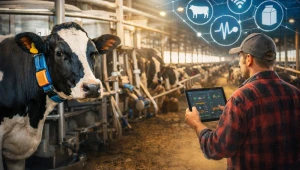
Over the past decade, dairy farms in the United States have quietly become one of the most technologically instrumented environments in agriculture. Sensors now monitor cows’ movement, rumination, body temperature, milk flow, and even subtle behavioral shifts that indicate illness or reproductive cycles. Artificial intelligence systems then process this data and translate it into operational decisions.
By 2026, this transition is no longer experimental. It is becoming embedded in the operational structure of modern dairy management.
The shift toward sensor-based management did not begin simply as a technological curiosity. It emerged from deeper structural pressures inside the dairy sector. Labor availability has tightened in many dairy regions. Herd sizes have increased, particularly in major dairy states such as Wisconsin, Idaho, Texas, and California. At the same time, profit margins remain highly sensitive to feed prices, milk market volatility, and veterinary costs.
Technology is increasingly filling the management gap created by these pressures.
Many dairy farms now operate with combinations of the following systems:
- Wearable health sensors attached to collars or ear tags
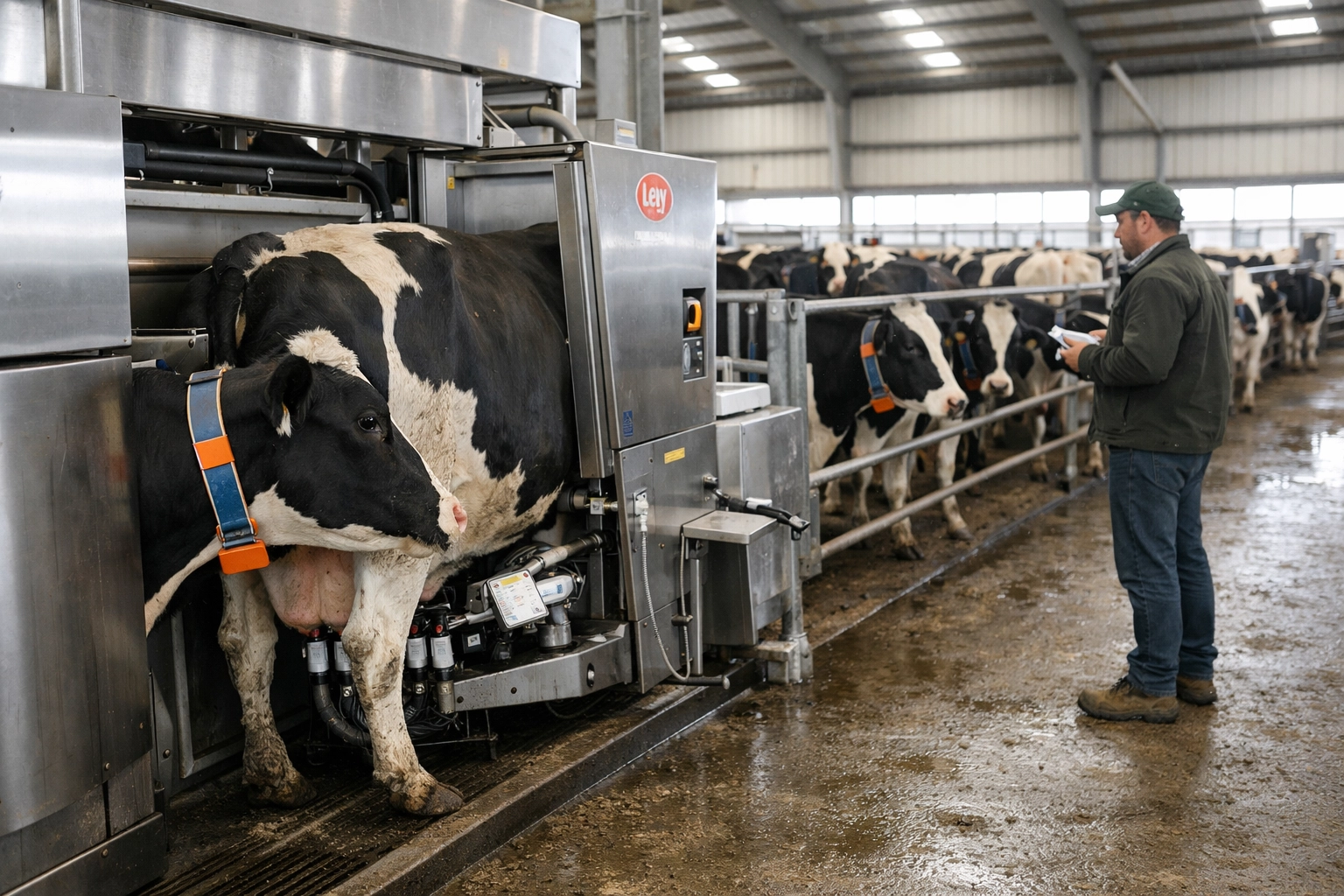
- Automated milking systems (AMS) using robotic units
- Machine-vision cameras tracking cow movement and body condition
- Barn environmental sensors measuring humidity, temperature, and air quality
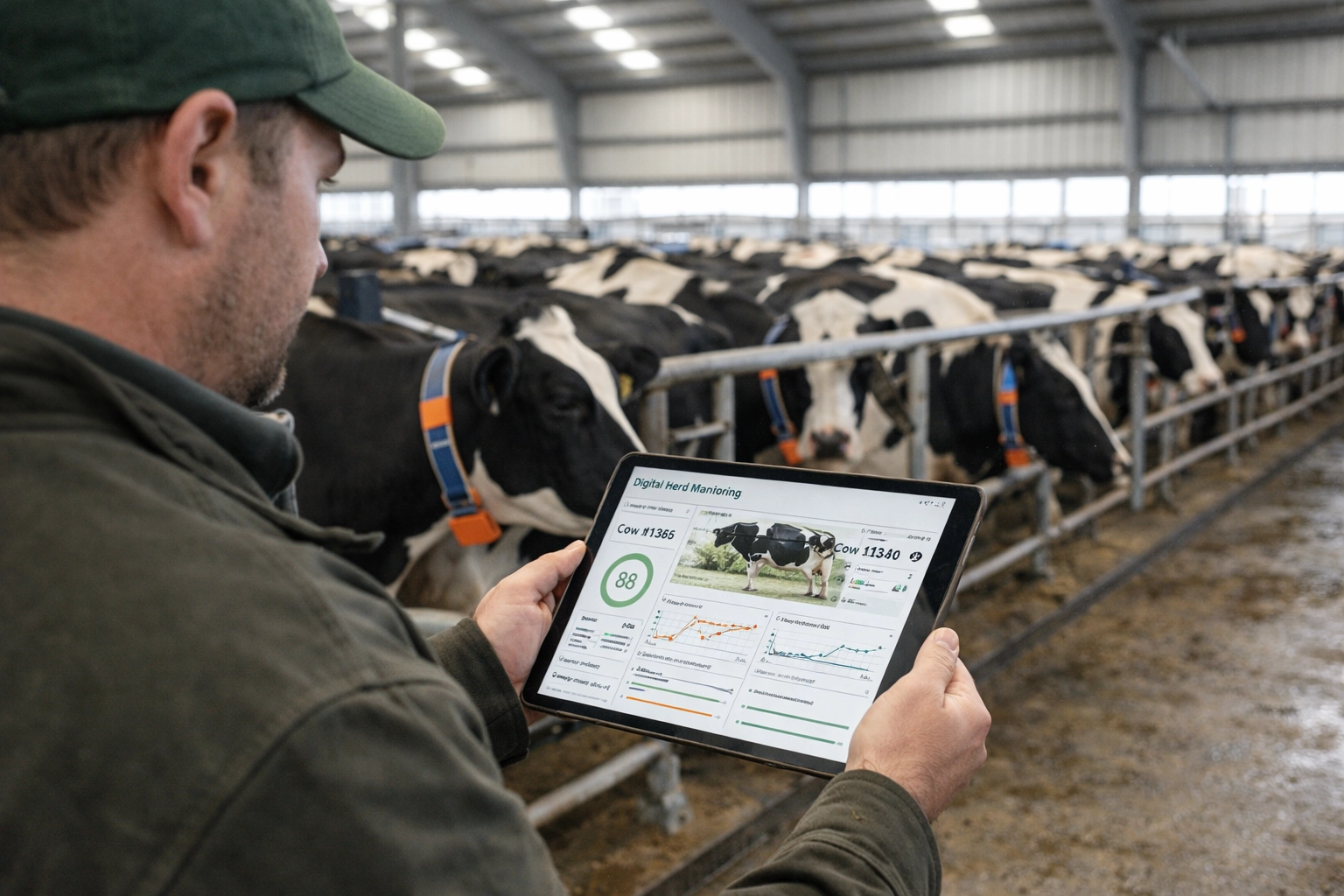
- AI dashboards analyzing herd data in real time
The core idea behind these systems is not automation alone. It is continuous biological monitoring.
Instead of relying only on periodic observation rounds, farms increasingly depend on digital alerts that detect early signs of mastitis, lameness, fertility cycles, or feeding inefficiencies.
Technology adoption has also followed the economic structure of the industry. Larger operations have adopted sensor systems much faster than smaller farms. According to data from the USDA Economic Research Service, dairy farms with several hundred cows or more are significantly more likely to invest in automated milking and advanced herd-management systems because labor savings and productivity gains scale with herd size. More detailed adoption patterns can be seen in ERS reports on the structure of the U.S. dairy sector:
https://www.ers.usda.gov/topics/animal-products/dairy/
However, adoption is no longer limited to large industrial dairies.
Mid-size farms are increasingly experimenting with partial deployments, such as reproductive monitoring sensors or activity trackers on specific cow groups. The technology is becoming modular rather than all-or-nothing.
Still, the strategic question remains unresolved.
Is AI-based herd monitoring becoming a competitive necessity in dairy farming, or is it simply a productivity upgrade that only some operations truly need?
The answer depends heavily on farm scale, labor structure, and financial resilience.
Economic Structure Driving Adoption
Behind the growing presence of sensors in dairy barns lies a set of economic forces reshaping farm management.
The first pressure is labor uncertainty.
Dairy farming requires daily, year-round labor. Unlike crop farming, milking schedules cannot pause during seasonal transitions. Many dairy operations have historically relied on immigrant labor, and availability has fluctuated with regional labor markets and immigration policy changes.
Automation offers one form of stability.
Robotic milking systems allow cows to enter milking stations voluntarily while sensors simultaneously measure milk yield, quality indicators, and health signals.
The second structural driver is herd scale.
Over the past two decades, the number of dairy farms in the United States has declined while the average herd size has grown substantially. Data from the United States Department of Agriculture shows that consolidation has reshaped the industry as larger farms absorb production capacity from smaller operations. Historical statistics on dairy herd size and productivity can be explored through USDA dairy data:
https://www.nass.usda.gov/Statistics_by_Subject/result.php?sector=ANIMALS%20%26%20PRODUCTS&group=DAIRY
Managing a herd of 1,000 or 2,000 cows through traditional observation alone becomes increasingly difficult. AI-enabled monitoring systems effectively act as digital herd supervisors, scanning thousands of behavioral data points every hour.
The third factor is biological risk management.
Dairy cows are high-value biological assets. A single untreated infection or reproductive failure can affect milk production for an entire lactation cycle. Early detection changes the economics dramatically.
AI monitoring systems track indicators such as:
- rumination time
- step count and walking patterns
- feeding frequency
- milk conductivity
- temperature variation
These signals often shift one to two days before visible symptoms appear.
Research funded through the National Institute of Food and Agriculture suggests that precision livestock technologies can significantly reduce disease losses by identifying health issues earlier than manual observation alone. Research initiatives supported by NIFA can be reviewed here:
https://www.nifa.usda.gov/research
But the same technologies that improve monitoring also introduce new financial and operational considerations.
Sensor networks, robotics, and data platforms require substantial capital investment. For some farms, the financial return depends heavily on herd size and operational efficiency.
Which raises the next question: where the risks lie in the sensor-driven dairy model.
Must Read

AI and Automation Are Reshaping U.S. Agriculture in 2026
Artificial intelligence and automation are rapidly transforming American agriculture. From precision spraying to autonomous machinery and data-driven crop management, new technologies are helping farmers improve efficiency while facing rising labor shortages and production costs.
Key Risks in the Sensor-Driven Dairy Model
While the promise of AI-enabled dairy management receives considerable attention, the risks receive far less discussion.
Several strategic vulnerabilities deserve careful consideration.
Technology Dependency
As farms integrate sensor networks into daily operations, management decisions increasingly depend on digital infrastructure.
A malfunction in the monitoring system can delay health alerts or produce inaccurate data. In highly automated barns, even milking schedules depend on system performance.
The risk is not simply technical failure. It is operational over-reliance.
Experienced farmers often note that technology must support observation rather than replace it. Subtle animal behavior changes can still escape automated detection.
Data Ownership and Platform Lock-In
Many precision dairy systems operate through proprietary cloud platforms. Sensor data from cows flows into software ecosystems controlled by equipment manufacturers.
This raises a strategic concern:
Who ultimately owns herd data?
If switching platforms requires migrating years of production and health records, farms may face vendor lock-in, limiting negotiating power over future equipment upgrades or subscription costs.
Data governance is becoming an increasingly important issue across agriculture as digital tools expand.
Capital Investment Risk
Robotic milking systems and advanced sensor infrastructure require significant upfront capital.
For large dairies, building barns designed for robotic milking may require several million dollars in equipment and facility modifications.
If milk prices fall, these investments can become difficult to service.
Agricultural economists studying dairy lending trends at the Federal Reserve Bank of Kansas City have noted that dairy farms often remain particularly sensitive to commodity price volatility compared with many crop operations. Their agricultural finance reports provide insight into farm debt pressures:
https://www.kansascityfed.org/agriculture/agfinance/
Technology can improve efficiency, but it does not eliminate market risk.
In some cases, heavy technology investment can increase financial exposure if milk markets weaken.
Skill Gap Risk
AI-driven farms require different management capabilities than traditional dairy operations.
Managers must interpret analytics dashboards, understand predictive alerts, and maintain sensor equipment. As a result, some farms are discovering that data literacy is becoming part of modern herd management.
Hiring skilled employees who can manage both animals and data systems is becoming increasingly important.
Also Read

How Precision Agriculture Data Is Changing Farm Decisions in 2026
Precision agriculture tools are giving farmers deeper insights into soil conditions, crop health, and input efficiency. In 2026, data-driven farming is helping producers make smarter planting, fertilization, and irrigation decisions across U.S. agriculture.
Strategic Options for Dairy Operators
Given these opportunities and risks, dairy farms are not simply deciding whether to adopt AI technologies. They are deciding how deeply to integrate them into their operations.
Several strategic pathways have emerged.
Full Automation Model
Large industrial dairies are increasingly building barns designed around robotics and sensors from the beginning.
This model typically includes:
- robotic milking systems
- full-herd wearable health sensors
- automated feed monitoring
- integrated data platforms
The advantage is operational efficiency. Fewer workers can manage much larger herds.
The risk lies in capital intensity and technological dependence.
Hybrid Monitoring Strategy
Many mid-size farms are adopting sensors selectively.
Rather than instrumenting every animal, farms monitor high-risk groups such as:
- early-lactation cows
- breeding groups
- animals with previous health issues
This approach captures the early-warning benefits of AI monitoring while controlling investment costs.
Minimal Technology Model
Some farms continue to rely primarily on traditional management practices.
These operations emphasize:
- experienced herd observation
- consistent labor teams
- simpler herd-management software
While this model reduces capital risk, it may become harder to sustain as herd sizes grow and labor shortages continue.
Technology Pathways Compared
| Strategy Model | Operational Advantage | Strategic Risk | Typical Farm Profile |
|---|---|---|---|
| Full AI Automation | Maximum labor efficiency and constant herd monitoring | High capital exposure and vendor dependence | Large dairies (1000+ cows) |
| Hybrid Sensor Adoption | Balanced investment with targeted health monitoring | Partial herd visibility | Mid-size farms (200–800 cows) |
| Minimal Technology | Low financial exposure | Higher labor requirements and slower disease detection | Small family dairies |
The comparison reveals a broader structural pattern within the dairy industry.
Technology adoption closely follows economic scale.
Large farms prioritize efficiency and labor savings, making automation economically attractive. Mid-size farms tend to experiment with partial technology deployment as a compromise between productivity and financial caution.
Small farms face the most complex strategic dilemma. They often lack the scale needed to justify large automation investments but still face the same labor shortages and disease risks affecting the broader industry.
As a result, technology adoption across dairy farming is uneven rather than universal.
Implications for Different Farm Sizes
The effects of AI-driven herd monitoring vary widely depending on farm scale.
Small Dairy Farms
Small dairies often rely on family labor and relatively modest herd sizes.
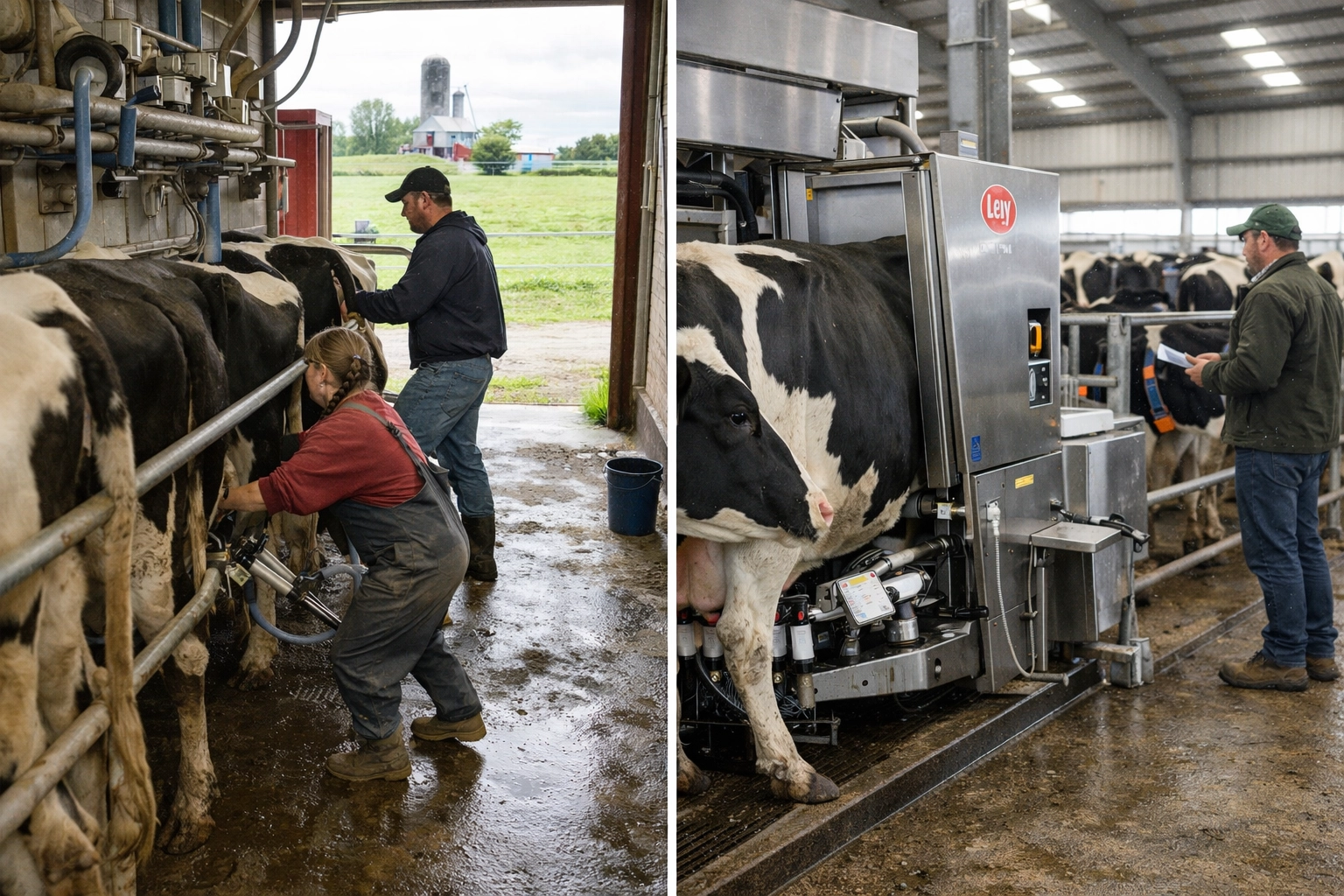
For these farms, full automation rarely makes financial sense. A robotic milking system designed for large barns may cost more than the annual revenue of a small operation.
Instead, targeted technologies such as reproductive monitoring sensors or basic activity trackers may offer more practical benefits.
However, smaller farms also face a structural challenge: many technology providers design their systems primarily for large commercial operations.
Mid-Size Dairy Operations
Mid-size farms represent the transition zone of the industry.
These operations often face strong pressure to modernize. Herds may be too large for purely manual management but not large enough to justify expensive automation infrastructure.
Hybrid systems therefore become common.
Sensors may monitor cow activity and health, while milking remains partly manual or semi-automated.
The goal is to increase management visibility without locking the farm into large capital commitments.
Large Industrial Dairies
For large dairy operations, AI monitoring is increasingly integrated into everyday management.
In a herd of several thousand cows, early detection of disease or reproductive cycles can significantly affect milk production and profitability.
These farms increasingly function as data-supported biological production systems.
However, the same scale that makes automation attractive also concentrates risk. Technology failures or software disruptions can affect thousands of animals simultaneously.
Also Read
U.S. Farms Are Facing a Water scarcity: Climate Pressure and Irrigation Challenges in 2026
Explore how water shortages and climate stress are impacting irrigation and farm productivity across the United States.
Looking Ahead: The Strategic Direction of Dairy Technology
The next phase of dairy technology development is likely to focus less on individual devices and more on integrated data ecosystems.
Future systems may combine sensor data with genetic information, environmental monitoring, and feed analytics to produce predictive models of herd performance.
Researchers working with the USDA Agricultural Research Service are already exploring machine-learning approaches that could forecast herd health trends and productivity patterns before problems occur. More information about ARS livestock research programs is available here:
https://www.ars.usda.gov/research/programs/
But the central question remains practical rather than technological.
Will AI systems simply become decision-support tools for farmers managing complex herds?
Or will dairy farms gradually evolve into highly automated biological production facilities where algorithms manage daily operations?
For now, most farms remain somewhere between these two models.
Even in technologically advanced barns, human judgment remains central to dairy management.
The sensors may be watching constantly, but it is still the farmer who decides what those signals ultimately mean.

Written by Janardan Tharkar – an agriculture content researcher and blogging professional with practical experience in farming education, digital publishing, and SEO content optimization. Janardan focuses on modern U.S. agriculture trends, smart farming technologies, irrigation systems, crop development, organic farming practices, and farmer-support programs to create helpful, practical, and trustworthy content for American readers.