How Data Is Quietly Reshaping Farm Strategy
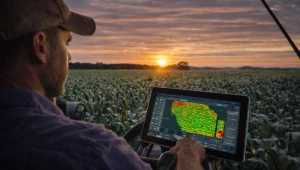
On a warm June morning in eastern Nebraska, a farmer slows his tractor as it approaches a slight rise in the field. The corn plants look uniform from the road—rows of green leaves stretching toward the horizon.
Inside the cab, however, the view is different.
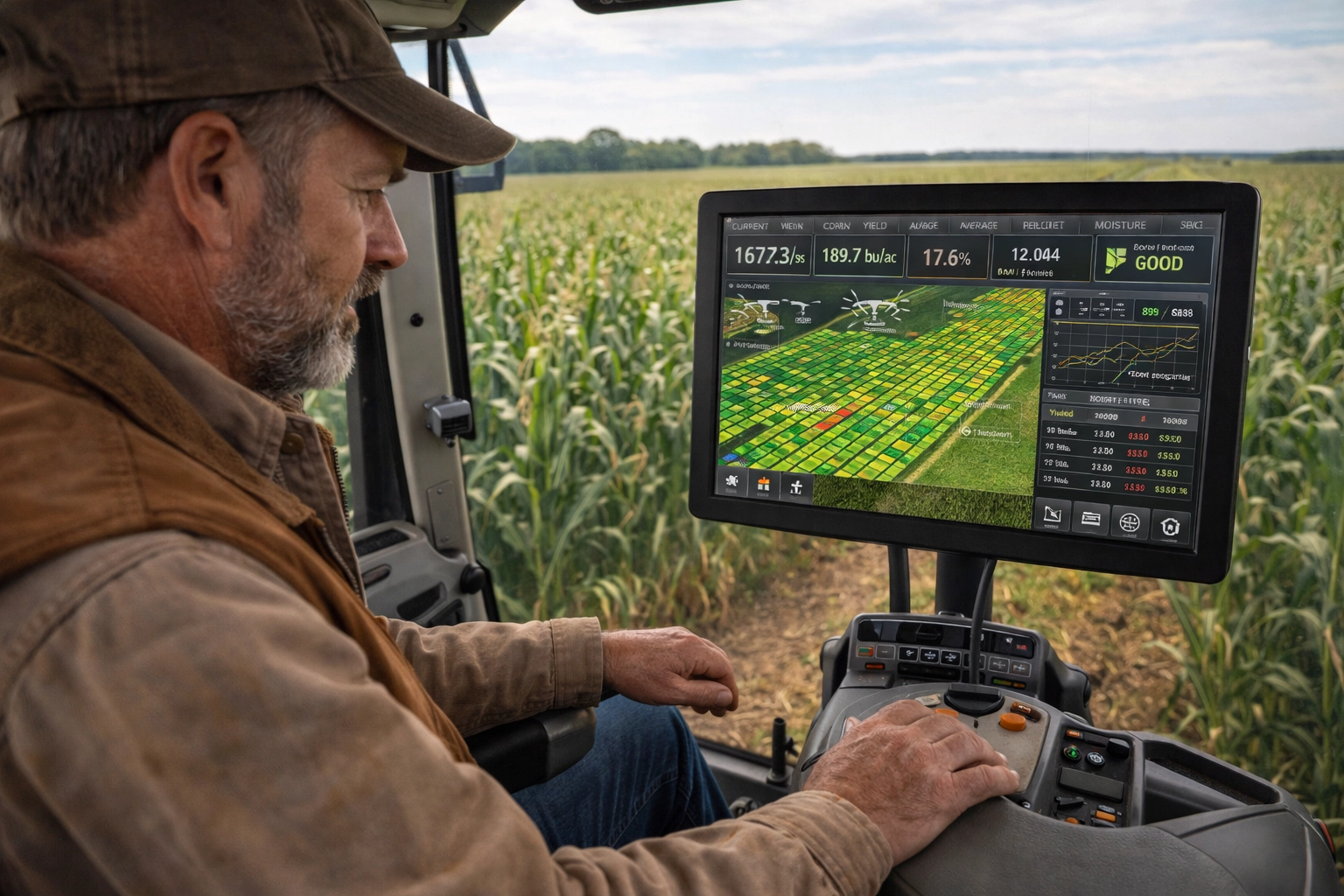
A digital screen mounted beside the steering wheel shows a color-coded field map. Green patches indicate strong nitrogen levels. Yellow areas suggest declining soil fertility. A narrow strip near the edge of the field shows moisture stress.
The farmer taps the screen and slightly adjusts the fertilizer rate.
The field itself has not changed.
But the way it is managed has.
This quiet moment captures what precision agriculture has become in 2026—not a futuristic experiment but a practical management system shaping everyday farm decisions across the United States.
Yet the rise of precision agriculture is not simply about technology. It is about strategy: how farmers use data to navigate rising costs, environmental pressure, and increasingly complex markets.
Why Precision Agriculture Is Becoming Central to Farm Management
Precision agriculture has evolved gradually over the past three decades. What began with GPS guidance systems in tractors has expanded into a sophisticated network of sensors, satellite imagery, data analytics, and automated equipment.
In 2026, precision agriculture includes technologies such as:
- variable-rate planting and fertilization
- satellite crop monitoring
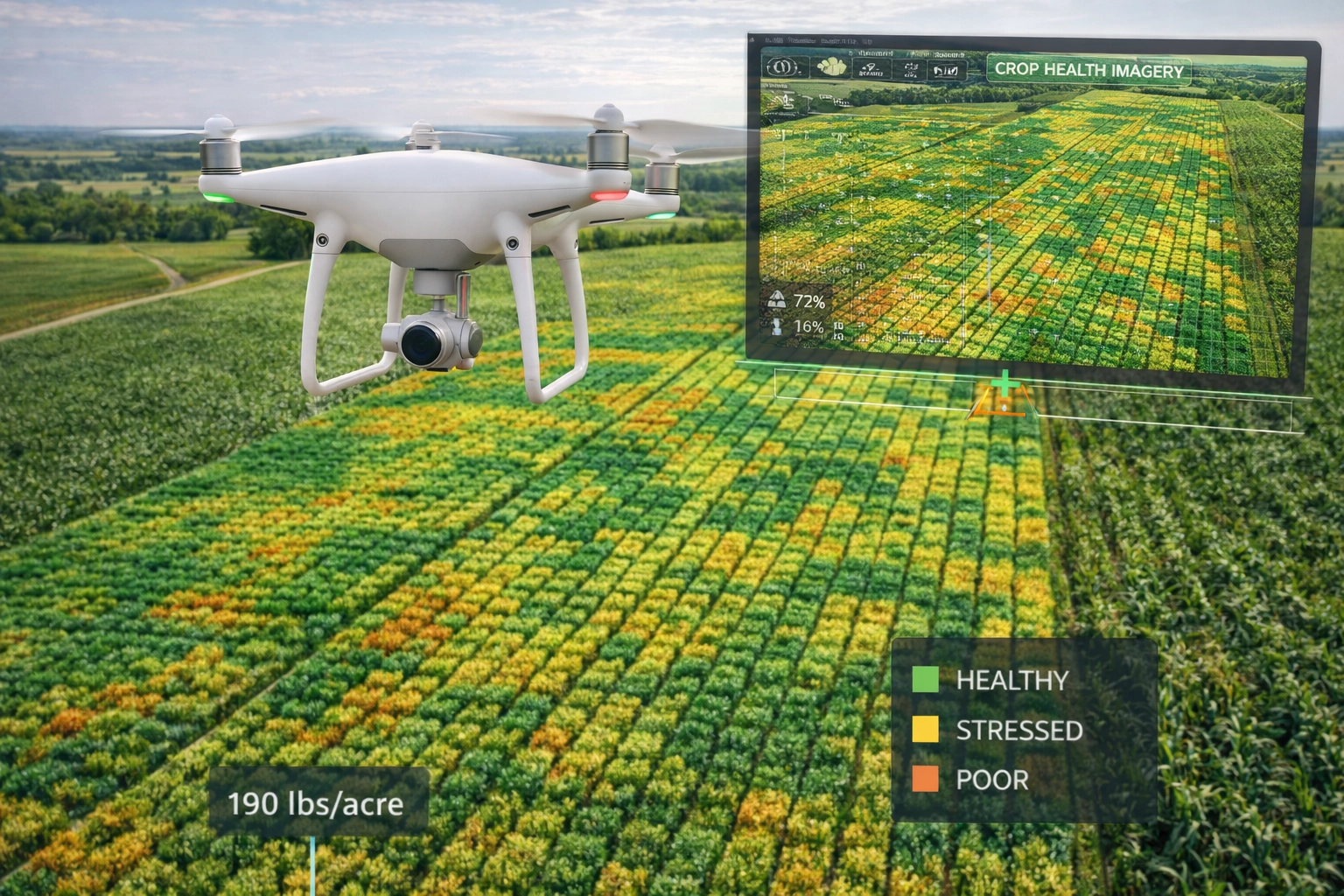
- drone-based crop imaging
- soil sensors measuring moisture and nutrients
- yield monitoring systems inside harvesters
- data analytics platforms predicting crop performance
The basic idea behind precision agriculture is straightforward: manage each part of a field according to its specific conditions rather than treating the entire field the same.
Fields that appear uniform from above often contain significant variation in soil composition, drainage, and nutrient availability.
Precision tools allow farmers to see those variations—and respond accordingly.
Research published by the USDA Economic Research Service shows that technologies such as GPS guidance and yield monitoring are now widely used across major U.S. crop farms (see: https://www.ers.usda.gov/topics/farm-practices-management/precision-agriculture/).
But the spread of these technologies raises deeper strategic questions.
Technology adoption does not automatically translate into better decision-making.

Must Read

How Precision Agriculture Data Is Changing Farm Decisions in 2026
Precision agriculture tools are giving farmers deeper insights into soil conditions, crop health, and input efficiency. In 2026, data-driven farming is helping producers make smarter planting, fertilization, and irrigation decisions across U.S. agriculture.
How Data Is Changing Everyday Field Decisions
To understand the practical impact of precision agriculture, consider one of the most expensive inputs in crop farming: fertilizer.
Traditional farming methods often applied fertilizer uniformly across entire fields. But soil productivity varies significantly even within small areas.
Precision agriculture allows farmers to adjust fertilizer application rates according to soil conditions.
In high-productivity zones, more nutrients may increase yield potential. In lower-yield areas, reducing fertilizer can save costs without sacrificing production.
Over hundreds or thousands of acres, these adjustments can have meaningful economic effects.
Agricultural surveys compiled by the USDA National Agricultural Statistics Service demonstrate how yield monitoring and variable-rate technology are increasingly integrated into modern crop systems (see: https://www.nass.usda.gov).
For many farmers, precision agriculture has become a tool for managing risk as much as improving productivity.
Yet the expansion of data-driven farming also introduces new vulnerabilities.

Where Precision Farming Introduces New Uncertainty
Precision agriculture often promises efficiency, but it also introduces complexity.
Farmers frequently identify three areas of concern.
Data Ownership
Precision agriculture generates enormous volumes of farm data—soil maps, yield histories, crop imagery, and input records.
Much of this data flows through proprietary software platforms controlled by equipment manufacturers or agricultural technology companies.
Some farmers worry about losing control over information generated on their own farms.
Capital Investment
Precision equipment is expensive. Advanced sensors, variable-rate controllers, drones, and software subscriptions require significant financial investment.
For large farms, these costs may be justified by operational scale.
For smaller farms, the return on investment is less certain.
Technology Dependence
Precision agriculture systems rely on software, connectivity, and technical maintenance.
If equipment fails during critical planting or fertilization periods, operational disruptions can occur.
Farmers must therefore balance technological efficiency with operational reliability.
The Data Ecosystem Supporting Modern Farming
Behind every precision agriculture system lies a vast infrastructure of agricultural data.
Public institutions play an important role in this ecosystem.
National crop production statistics compiled by the USDA National Agricultural Statistics Service provide foundational datasets used by researchers, agronomists, and farm management platforms (see: https://www.nass.usda.gov/Publications/).
Weather data also plays a critical role.
The National Oceanic and Atmospheric Administration provides climate observations and forecasts that feed agricultural modeling systems (see: https://www.noaa.gov/climate).
These public data systems support many private agricultural technologies.
Yet as digital tools become more central to farming, questions about data governance and technology control are becoming more prominent.
Read Also

AI and Automation Are Reshaping U.S. Agriculture in 2026
Artificial intelligence and automation are rapidly transforming American agriculture. From precision spraying to autonomous machinery and data-driven crop management, new technologies are helping farmers improve efficiency while facing rising labor shortages and production costs.
Different Strategic Paths Toward Precision Agriculture

Farmers do not adopt precision agriculture in a single uniform way. Instead, they follow different strategic pathways depending on resources, risk tolerance, and operational goals.
| Strategy | Technology Use | Cost Exposure | Decision Style |
|---|---|---|---|
| Traditional Farming | Minimal digital tools | Low capital cost | Experience-based decisions |
| Selective Precision Tools | GPS guidance and yield monitoring | Moderate investment | Hybrid decision-making |
| Fully Integrated Precision Systems | Advanced analytics and automation | High capital investment | Data-driven management |
This comparison highlights an important reality.
Precision agriculture is not a single technology but a range of management approaches.
Many farms begin with simple GPS guidance systems before gradually expanding into more sophisticated analytics tools.
What These Strategies Reveal About Farm Decision-Making
Looking at these strategies more closely reveals that the most successful farms often adopt a hybrid approach.
Experience still plays a central role in farming decisions. Precision tools simply provide additional information.
Farmers who rely exclusively on technology risk overlooking field observations that cannot easily be captured by sensors.
At the same time, ignoring data entirely may leave efficiency gains unrealized.
The balance between digital analysis and human judgment often defines successful precision agriculture strategies.
The Capital Question Behind Digital Farming
Precision agriculture requires substantial capital investment.
Modern farm equipment increasingly integrates digital systems—GPS guidance, automated steering, yield monitors, and data collection platforms.
These technologies improve efficiency but also increase machinery costs.
Regional agricultural credit conditions reported by the Federal Reserve Bank of Kansas City indicate that machinery and technology purchases remain major sources of farm borrowing across the Midwest (see: https://www.kansascityfed.org/agriculture/ag-credit-survey/).
For farmers evaluating precision agriculture investments, the financial calculation often extends across several growing seasons.
Short-term returns may be limited.
Long-term benefits—improved yield stability, reduced input waste, and better soil management—may justify the investment.
Why Farm Size Shapes Technology Strategy
Precision agriculture affects farms differently depending on their scale.
Large Farms
Large operations managing thousands of acres often benefit most from digital tools.
Small efficiency improvements across large acreage can translate into significant financial gains.
Mid-Sized Farms
Mid-sized farms face a more complicated calculation. Technology may improve efficiency, but investment costs must be carefully balanced against operating margins.
Many adopt precision systems gradually.
Small Farms
Smaller farms often prioritize flexibility and financial stability.
Some adopt selective technologies—such as drone imagery or soil sensors—while relying primarily on traditional management approaches.
Service providers offering data analytics may allow smaller farms to access precision tools without purchasing expensive equipment.
Read Also

Right to Repair: Farmers vs Equipment Software
The rise of software-controlled tractors has sparked a major debate in agriculture. Explore the issue in our guide on Right to Repair for Farmers.
Where Precision Agriculture May Be Heading Next
Looking ahead, precision agriculture will likely evolve alongside developments in artificial intelligence, remote sensing, and robotics.
Machine-learning algorithms are increasingly capable of analyzing crop health patterns using satellite imagery.
Autonomous equipment may eventually perform certain field operations with minimal human intervention.
Yet the future of precision agriculture will depend not only on technology but also on institutional frameworks governing agricultural data.
Farmers, policymakers, and technology companies must navigate questions about data privacy, interoperability, and long-term platform control.
These issues will shape the next phase of digital farming.

Back in the Field
Late in the afternoon, the Nebraska farmer finishes applying fertilizer across the final section of the field.
From the road, the landscape appears unchanged—rows of corn stretching toward the horizon.
But inside the tractor’s digital map, the field is divided into dozens of zones, each with slightly different nutrient levels.
Precision agriculture has not replaced traditional farming knowledge.
Instead, it has layered new information onto centuries-old agricultural practices.
For farmers willing to navigate that complexity, the result is a new kind of agriculture—one where decisions are shaped not only by soil and weather, but by data as well.

Written by Janardan Tharkar – an agriculture content researcher and blogging professional with practical experience in farming education, digital publishing, and SEO content optimization. Janardan focuses on modern U.S. agriculture trends, smart farming technologies, irrigation systems, crop development, organic farming practices, and farmer-support programs to create helpful, practical, and trustworthy content for American readers.